Prediction Markets: How Prediction Markets Work
🇬🇧 Global Industry – March 10, 2026 – www.zonadeazar.com Prediction Markets are platforms where participants buy and sell financial contracts based on the outcome of future events. These events may include political elections, economic indicators, weather phenomena, sports results, or even corporate decisions.
Although the concept has existed for decades in academic and financial environments, the growth of digital platforms and blockchain technology has accelerated its expansion in recent years, generating regulatory debates in several countries.
Overview
In a Prediction Market, users do not place bets directly as they would with a traditional sportsbook. Instead, they buy or sell contracts whose value depends on the probability of a future event occurring.
Each contract represents a statement about the future. For example:
-
“Candidate X will win the election”
-
“Team A will win the championship”
-
“US inflation will exceed 3% this year”
Participants buy these contracts when they believe the event will occur and sell them when they believe it will not.
The price of each contract fluctuates according to supply and demand, reflecting the probability collectively assigned by the market to the event.
How The Market Operates
The operation of a Prediction Market generally follows several steps:
1. Event Creation
The platform defines a verifiable event with a specific resolution date.
Example:
“Will Team X win Sunday’s match?”
2. Contract Issuance
Contracts are created that typically pay 1 dollar or 1 token if the event occurs, and 0 if it does not occur.
These contracts can be traded before the event is resolved.
3. Price Formation
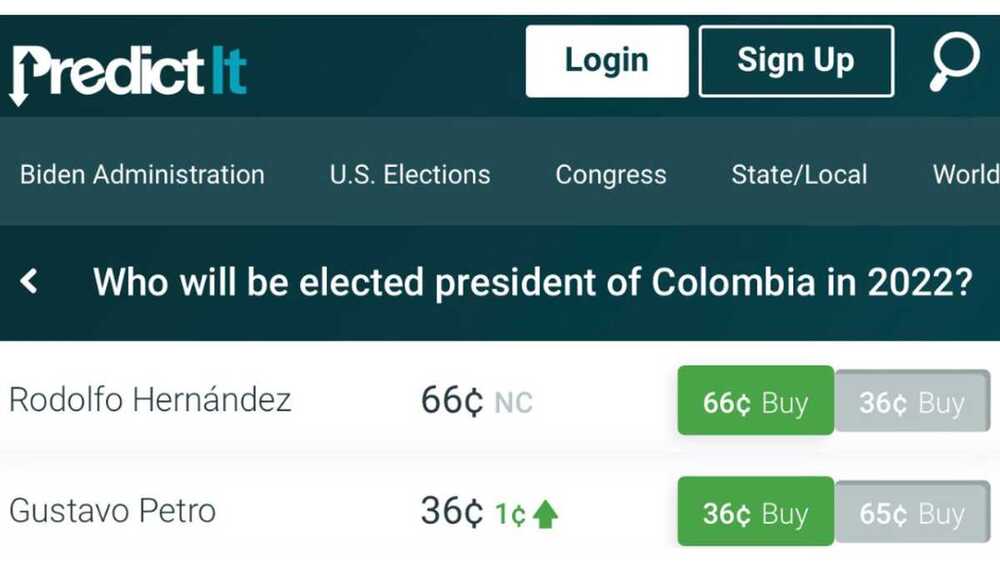
The contract price reflects the implied probability.
Example:
-
If the contract trades at 0.70, the market estimates a 70% probability of the event happening.
-
If it trades at 0.25, the market estimates 25% probability.
Users may buy if they believe the probability is higher or sell if they believe it is lower.
4. Trading Between Participants
Contracts are traded in a marketplace similar to financial exchanges:
-
some participants buy
-
others sell
-
prices adjust in real time
This allows traders to enter or exit positions before the event is resolved.
5. Event Resolution
Once the event occurs — or does not occur — the market settles.
-
If the event occurs → each contract pays 1 monetary unit
-
If the event does not occur → the contract is worth 0
Users who bought contracts at lower prices may profit by selling earlier or collecting the payout at settlement.
Practical Example
Suppose there is a market based on a football match.
Event:
“Brazil wins the match against Argentina”
Contract: pays 1 dollar if Brazil wins.
Scenario:
-
Initial price: 0.60
-
A user buys 100 contracts → pays 60 dollars
If Brazil wins:
-
receives 100 dollars
-
profit → 40 dollars
If Brazil loses:
-
the 60 dollar investment is lost.
Differences From Sports Betting
Although they may appear similar, Prediction Markets differ from traditional betting systems.
Sportsbooks
-
odds set by the operator
-
operator assumes the risk
-
users bet against the house
Prediction Markets
-
prices determined by the market
-
users trade against each other
-
the platform simply facilitates transactions
In this sense, they function more like a financial market for probabilities.
Academic And Economic Uses
Prediction Markets have been used by universities and corporations to:
-
forecast election results
-
estimate economic indicators
-
predict product sales
-
evaluate business decisions
Several studies suggest that these markets can sometimes predict outcomes more accurately than polls or statistical models.
Regulatory Debate
The growth of these platforms has triggered regulatory debates across multiple jurisdictions.
Authorities are evaluating whether Prediction Markets should be classified as:
-
financial instruments
-
derivatives products
-
informational platforms
-
or simply a form of betting.
The central issue is that participants assume financial risk tied to uncertain outcomes, which can resemble gambling structures.
For this reason, some countries regulate them under gaming laws, while others treat them as financial market instruments.
Future Outlook
With the expansion of blockchain technology, smart contracts and decentralized platforms, Prediction Markets are evolving into increasingly global and accessible systems.
Their development poses new challenges for regulators and policymakers, who must balance technological innovation, consumer protection and market integrity.
Regardless of the regulatory path, Prediction Markets are emerging as an important tool for analyzing probabilities, interpreting collective information and anticipating future events.
🔗 Editó: @_fonta www.zonadeazar.com