The Match Lifecycle: Where Traffic Really Happens – Beyond the Coverage Gap
Switzerland November 19,2026 www.zonadeazar.com Most sports publishers are not capturing the full value of the games they cover. This isn’t a question of content quality, and it isn’t even a question of content volume; it’s a question of participation. More specifically, it’s participation across the full spectrum of audience demand.
The gap between what could be captured and what actually is results in measurable losses in traffic, engagement, and ultimately revenue. But to understand why that gap exists, we need to go deeper. Because the real issue isn’t just how much content is being produced, it’s how publishers fundamentally think about a game.
The Wrong Model
For decades, sports media operated on a simple timeline: the game happens, the story is written, and the audience consumes the result. Under this model, a game is treated as a single point of engagement, one moment that begins with kickoff and ends with the final whistle.
That assumption no longer reflects reality. Today’s sports fan doesn’t just engage with outcomes; engagement starts with anticipation, builds through context, and continues well after the game ends. Audiences don’t show up once they return repeatedly, interacting with content across multiple moments rather than a single event.
Demand Has Become Continuous
Fan behavior has fundamentally shifted.
Instead of a single interaction, engagement now happens across a multi-day cycle:
- Days before the game: research and anticipation
- Hours before kickoff: planning and intent
- During the game: real-time interaction
- After the game: analysis and interpretation
- Days later: reflection and forward-looking interest
This is not anecdotal – it is measurable:
- Traffic during live games can increase by 3–5x compared to standard publishing days
- Returning visitors account for 25–35% of total pageviews
- Multi-device usage continues to rise, with fans using second screens for live engagement
This behavior is not a trend. It is the new baseline.
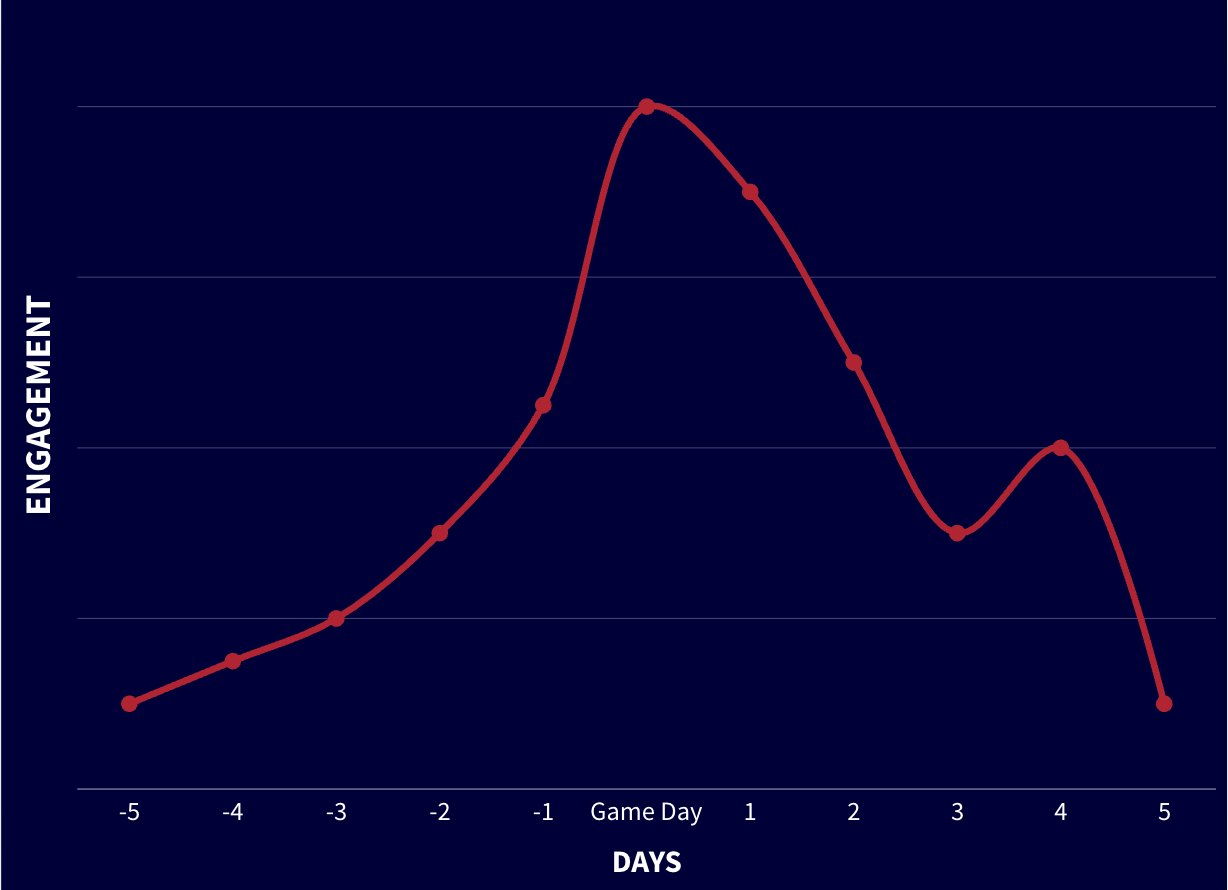
Caption: Fan engagement builds before the game, peaks during play, and remains active well beyond the final whistle.
The Sports Content Lifecycle
Where audience demand emerges, peaks and gets missed.
The Build-Up
Early Demand • Low Competition
What’s happening
- Early demand emerges
- Low competition = opportunity
Content Ideas
- Injury reports
- Team form trends
- Historical matchups
Recommendation: Publish early to capture demand before competitors
Pre-Game Peak
Rising Intent • Expanding Gaps
What’s happening
- Demand spikes 3–5x pre-game
- Browsing turns to deciding
Content Ideas
- Viewing guides
- Predictions & odds analysis
- Key players to watch
Recommendation: Capture intent before peak kickoff traffic
Live
Peak Attention • Maximum Value
What’s happening
- Peak attention
- Fans engage & track
Content Ideas
- Live stats dashboards
- Real-time highlights/updates
- Play-by-play coverage
Recommendation: Drive engagement and monetization with real-time content
Post-Game
High Effort • High Competition
What’s happening
- Recaps focus
- Immediate competition peak
Content Ideas
- Game recaps
- Key moment breakdowns
- Player reactions
Recommendation: Differentiate or deprioritize the most crowded stage.
Aftermath
Retention • Loyalty Driver
What’s happening
- Interest shifts to insights
- Users seek analysis & context
Content Ideas
- Advanced stats
- Fantasy impact
- Future implications
Recommendation: Invest in depth to drive repeat visits and loyalty.
The Structural Imbalance
When viewed together, the lifecycle reveals a consistent and measurable imbalance in how publishers allocate their resources relative to actual audience demand.
Early stages, such as build-up and pre-game, offer high visibility and relatively low competition, yet remain undercovered. Search-driven demand begins days in advance, often with limited supply, creating an opportunity to capture traffic before it becomes contested. In contrast, the post-game recap, the most heavily covered stage, is also the most saturated, with dozens of publishers competing simultaneously for the same audience and search rankings.
The live window presents the most valuable opportunity in the entire lifecycle. During live play, traffic can increase by 3–5x, engagement deepens, and ad inventory refreshes continuously, yet most publishers can only support live coverage for a fraction of total games. At the same time, the aftermath stage, which drives 25–35% of total pageviews through returning users, remains significantly underinvested despite its role in retention and long-term audience value.
The result is a structural mismatch:
- High-opportunity stages are under-resourced
- High-investment stages are the most competitive
- High-value engagement windows are inconsistently covered
This is not a marginal inefficiency; it is a systemic misalignment between supply and demand.
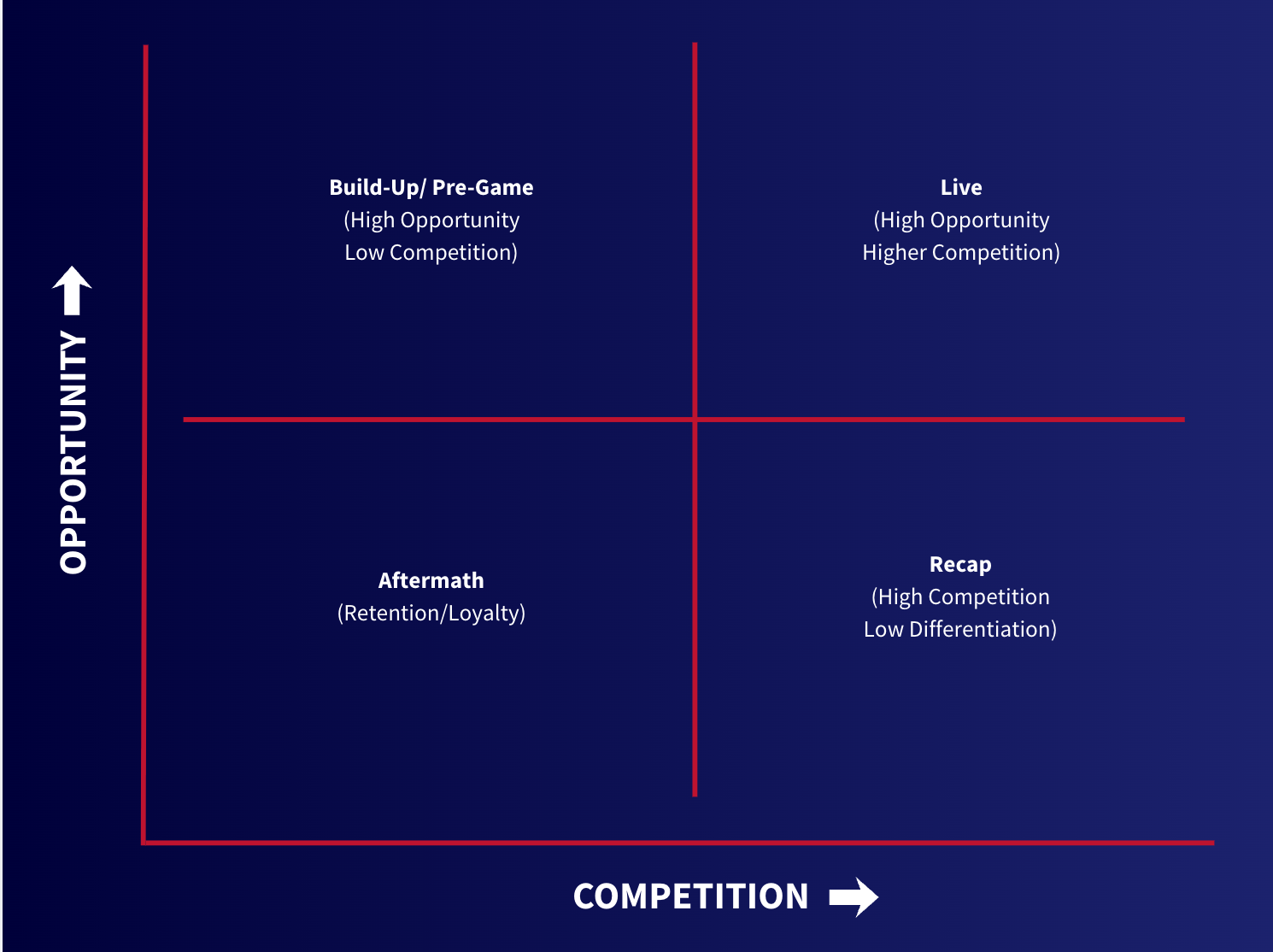
Caption: Publishers overinvest in the most competitive stage while underutilizing higher-growth opportunities
Why This Matters More Now Than Ever
This imbalance is not static. It is accelerating, driven by structural shifts in how audiences consume content and how value is created.
- Audience Fragmentation Has Increased the Number of Engagement Moments
Audiences are no longer concentrated around a single moment or platform. A single fan may interact with content across multiple devices, watching a game on one screen while simultaneously checking stats, highlights, or commentary on another.
As a result, engagement is no longer episodic; it is continuous. Capturing attention now requires publishers to show up across multiple moments, not just one. Those who fail to do so don’t just miss a visit. They miss a series of potential interactions that would have compounded over time.
- Search Has Become a Continuous Visibility Battle
Search remains one of the largest drivers of traffic, accounting for 20–40% of publisher sessions. However, search visibility is no longer secured by publishing a single high-performing piece of content.
Instead, ranking and visibility are influenced by:
- consistency of publishing
- freshness of content
- coverage across multiple related queries
For example, a publisher that produces preview content, live updates, recaps, and follow-up analysis creates multiple entry points into search. A publisher that only produces a recap competes in a single, highly saturated moment and often loses visibility as a result.
- Monetization Is Increasingly Tied to Engagement Depth
Not all pageviews carry the same value.
High-intent, highly engaged users, particularly those who return multiple times, generate significantly more monetizable impressions over time. Live engagement, in particular, can command 1.5–3x higher CPMs, while returning users drive deeper sessions and higher total pageviews per user.
Lifecycle coverage is what creates this type of audience behavior. Recap-only strategies capture a single interaction. Lifecycle strategies generate multiple sessions per user, increasing both reach and revenue efficiency.
The Shift That Changes Everything
The implication is not that publishers need to produce more content. They need to rethink how they define a game fundamentally.
A game is no longer a single event tied to a final score.
It is a sequence of engagement opportunities that unfold over time.
This shift reshapes how value is created:
- Traffic is no longer captured in one moment; it accumulates across multiple stages
- Audiences no longer visit once; they return across the lifecycle
- Revenue no longer depends on a single spike; it compounds through repeated engagement
Publishers that adopt this model do not simply increase output.
They increase:
- traffic per game
- sessions per user
- revenue per audience
What Comes Next
Understanding the lifecycle reveals where the opportunity exists, but it also highlights a more urgent issue.
Because when these opportunities aren’t captured, they don’t disappear.
They are captured by someone else.
@_fonta


