Brazil: Lula Pushes for Betting Ban Approval by Year-End Amid Legal Disputes
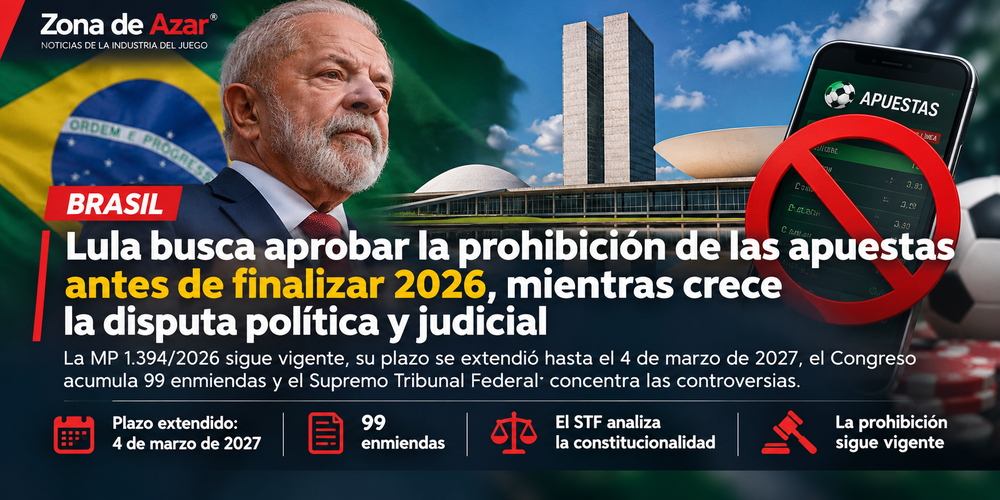
🇧🇷 Brazil: Lula Seeks to Secure Approval of Betting Ban Before the End of 2026 as Political and Legal Disputes Intensify. Provisional Measure (MP) 1,394/2026 will remain in force while its legislative consideration continues, with the final deadline extended to 4 March 2027. Congress has received 99 amendments, the joint committee has yet to begin its work, and the Federal Supreme Court is overseeing the constitutional disputes. The future of Brazil’s sports betting and online gaming market remains uncertain.
Brazil, 24 November 2026 – Zona de Azar® – President Luiz Inácio Lula da Silva’s government is stepping up negotiations with the National Congress in an effort to secure approval of Provisional Measure (MP) 1,394/2026 before the end of the year. The measure introduced a nationwide ban on fixed-odds betting.
On Monday, 23 November, Senator Randolfe Rodrigues (PT-AP), the government’s leader in Congress, confirmed that the Executive remains committed to securing a vote in 2026, although its immediate priority is the approval of the fiscal adjustment package.
The political objective is to settle the matter before the new parliamentary composition takes office in February 2027.
However, difficulties in establishing the joint committee, numerous proposed amendments and the constitutional challenges under judicial review have left the outcome of the process unresolved.
Congress Extends Deadline Until March 2027
Provisional Measure 1,394/2026 was published on 25 September 2026 and took legal effect immediately.
Congress initially had until 23 November to complete its consideration. However, under Act No. 118/2026 of the Presidency of the National Congress Bureau, its validity was extended by a further 60 days.
The new official deadline is 4 March 2027.
The extension takes into account the suspension of constitutional deadlines during the parliamentary recess.
This means that the ban remains in force, although it has not yet become permanent legislation approved by both chambers of Congress.
Meanwhile, the joint committee responsible for examining the measure has yet to be established. According to information available on 23 November, 13 appointments remain outstanding among full and substitute members.
The absence of all appointments does not necessarily prevent the committee from being established; the main obstacle is that the required quorum has not yet been reached.
The 99 Amendments Open Up Different Scenarios for Betting
One of the most significant developments is the submission of 99 parliamentary amendments to the original text, although some were subsequently withdrawn.
The proposals reflect different positions regarding the future of the industry.
Among the alternatives under consideration is the possibility of maintaining the ban on online casino games while allowing betting on real sporting events to resume.
Other initiatives seek to strengthen advertising restrictions, amend enforcement mechanisms, introduce additional consumer protection measures or review the conditions attached to previously granted licences.
Some proposals also aim to reinstate authorisations granted under the regulatory framework established by Law 14,790/2023.
None of these alternatives has been approved so far.
Consequently, the submission of amendments does not change the restrictions currently in force.
Federal Supreme Court Takes Centre Stage in Constitutional Dispute
Alongside the parliamentary debate, Brazil’s Federal Supreme Court (STF) has become another key arena in determining the future of the betting industry.
Justice Luiz Fux, the reporting justice in the constitutional proceedings, ordered the nationwide suspension of legal cases challenging the validity of Provisional Measure 1,394/2026 before lower courts.
The decision, officially announced by the STF on 9 November, followed a request from the Office of the Prosecutor General, which warned of the risk of conflicting judicial rulings.
The Supreme Court is examining four Direct Actions of Unconstitutionality: ADI 8024, 8027, 8028 and 8035.
The suspension of lower-court proceedings will remain in place until the STF reaches a final decision on the constitutional dispute, while the interim order must be submitted to the Court’s full bench for confirmation.
Importantly, this decision does not yet constitute a final ruling on the constitutionality of the ban.
The CDA Gaming Case and the Reversal of a Court Decision
A particularly significant development for betting operators occurred during the first days of November.
A provisional court ruling had allowed CDA Gaming, associated with the Casa de Apostas, Betsul and Jogo Online brands, to resume operations.
However, on 6 November, the Presidency of the Federal Regional Court for the Third Region (TRF-3) granted an appeal filed by the Office of the Attorney General of the Union (AGU), suspending that authorisation.
As a result, the exceptional permission that had benefited those platforms was overturned.
The case illustrates the tensions between operators challenging the termination of their licences and the authorities maintaining the general application of the measure.
Government Temporarily Withdraws Urgency Request for Another Anti-Betting Bill
The debate extends beyond Provisional Measure 1,394/2026.
On 17 November, the Brazilian Government withdrew its request for constitutional urgency regarding Bill 5,477/2026, an initiative seeking to establish criminal offences and prison sentences relating to the operation and promotion of fixed-odds betting.
The decision was intended to ease the legislative agenda in the Chamber of Deputies and allow other priorities, particularly fiscal adjustment measures, to proceed.
The Minister for Institutional Relations, José Guimarães, indicated that the Government intends to submit another urgency request at a later stage.
The withdrawal of the urgency request for the criminal legislation does not affect the validity of the Provisional Measure currently banning betting.
At the same time, the Chamber has grouped together other legislative proposals seeking additional bans and restrictions on the market.
Economic, Sporting and Advertising Impact
The September measure ordered the closure of fixed-odds sports betting and online gaming activities, both through physical establishments and digital platforms.
It also provided for the termination of licences, mechanisms for returning customer balances and restrictions on financial transactions associated with betting activities.
From 6 October, platforms covered by the ban were required to stop offering betting services to Brazilian consumers. The formal termination of licences was scheduled for 25 October.
The ban also covers advertising, marketing and sponsorship activities relating to fixed-odds betting aimed at Brazilian audiences.
Its impact therefore extends beyond operators to sports clubs, suppliers, marketing agencies and other participants in the commercial ecosystem.
The economic consequences also affect public finances. According to official estimates submitted to Congress, the ban is projected to reduce tax revenues by approximately BRL 1.541 billion in 2026, BRL 5.150 billion in 2027 and BRL 5.330 billion in 2028.
These figures are government projections rather than tax revenue losses already recorded.
Public Health Versus Regulation: Two Opposing Positions
The Brazilian Executive has justified the ban on the grounds of consumer protection and the prevention of gambling-related harm.
Senator Humberto Costa (PT-PE) publicly supported the measure during a parliamentary intervention on 11 November.
He cited figures attributed to the Ministry of Health indicating that approximately 28 million Brazilians had placed bets during the previous twelve months and that around 11 million displayed at-risk gambling behaviour.
He also stated that betting company sponsorships accounted for approximately 7% of the revenues of Série A football clubs in 2025.
The Brazilian Institute for Responsible Gaming (IBJR), representing the private sector, maintains a different position.
The organisation argues that the regulatory framework introduced in 2025 made it possible to implement identity verification systems, access restrictions, self-exclusion mechanisms, financial controls and the monitoring of licensed operators.
In an institutional statement issued in November, the IBJR highlighted figures it had presented indicating that more than 66,000 illegal websites had been blocked and 1.2 million people had used centralised self-exclusion mechanisms by August 2026.
Its central argument is that eliminating the legal supply of betting services does not guarantee the disappearance of consumer demand and could encourage gamblers to migrate to unlicensed platforms.
These opposing positions remain part of the ongoing parliamentary and judicial debate.
What Could Happen Next in Brazil?
Several institutional outcomes remain possible.
Congress may approve the Provisional Measure in its original form, introduce amendments or reject it. If the legislative process is not completed within the established deadline, the measure will cease to have effect under the applicable constitutional framework.
Any loss of validity would open a new legal phase to determine the consequences for terminated licences and legal relationships established while the ban was in force. It would not necessarily mean that all platforms could immediately resume operations.
Independently, the Federal Supreme Court must resolve the constitutional challenges against the measure.
4 March 2027 therefore stands out as a decisive date in the industry’s legislative calendar.
Brazil Approaches the End of 2026 Without a Definitive Resolution
Almost two months after the publication of Provisional Measure 1,394/2026, Brazil continues to undergo a major transformation in its betting policy.
The Government is seeking to turn the ban into permanent legislation, while different parliamentary groups are putting forward alternatives ranging from maintaining the restrictions to partially restoring regulated sports betting.
Meanwhile, the judiciary continues to examine the constitutional questions involved.
For international companies, regulators, sports organisations and gaming industry professionals, the development of this process will be essential in shaping investment decisions, contractual arrangements, compliance strategies and future opportunities to operate.
For now, the ban remains in force. Whether it becomes permanent, is amended or ultimately gives way to a different regulatory framework will depend on legislative and judicial decisions that are still pending.
Zona de Azar® will continue to follow developments concerning Provisional Measure 1,394/2026, decisions taken by the National Congress and rulings issued by the Federal Supreme Court.
Zona de Azar® | International Gaming Industry News.
🇪🇸 Más Noticias: www.zonadeazar.com
🇬🇧 More News: www.zonadeazar.com

