“Game Changers” Interview: Erkki Nikunen, Founder of “Kaamos Studios”
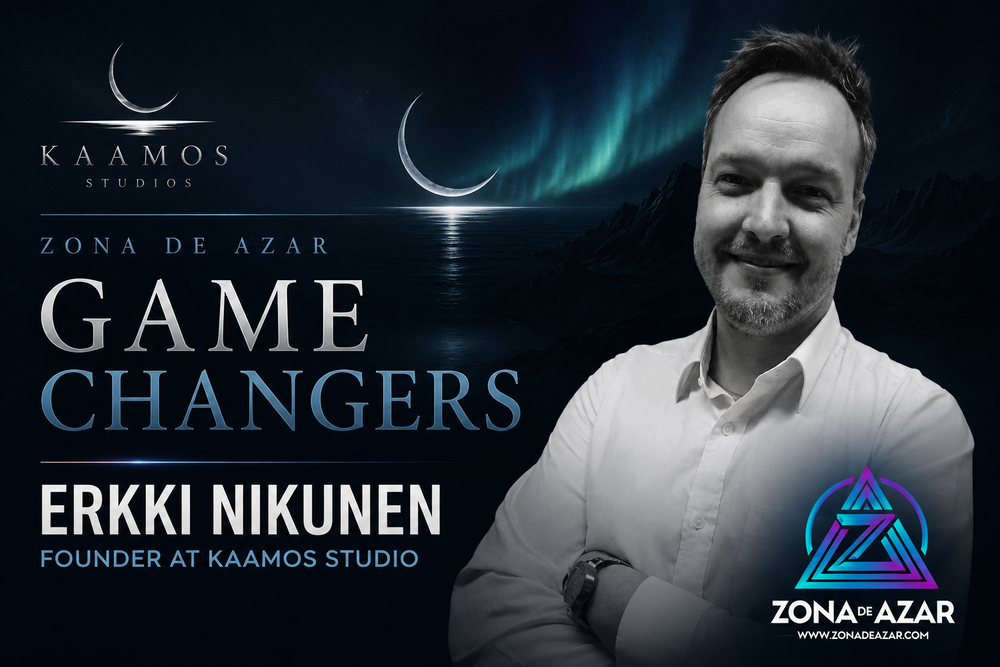
Finland.—September 4, 2026 www.zonadeazar.com What if the future of slots weren’t about making more noise, but about creating experiences that players will truly remember?
With that premise comes Kaamos Studios, a new studio seeking to make its mark in the iGaming industry with an unmistakable identity: “Nordic noir. Timeless games.” Inspired by Nordic noir, Finnish sisu, and Scandinavian minimalism, the company focuses on premium slots where atmosphere, tension, and the payoff take center stage.
Faced with a market that Kaamos considers saturated with stimuli, repetitive themes, and experiences designed for the short term, the studio proposes exactly the opposite: less noise, more identity. Its philosophy targets experienced players and high-value segments, with medium-high and high volatility titles, a strong visual presence, and moments that are less frequent but more memorable.
But the approach isn’t limited to aesthetics. Artificial intelligence is also part of its development strategy, used to accelerate creative processes—from concepts and characters to assets and game construction—while maintaining, as the studio explains, human oversight of the design, balance, and final product.
With a roadmap that calls for two monthly releases and titles such as Black Ice, Taipei Nights, Beastwood, and Aurora Syndicate, Kaamos sums up its ambition in a single sentence that says a lot about the brand: they don’t want to release the most games; they want to release the most distinctive ones.
Zona de Azar spoke with Erkki Nikunen, one of the founders of Kaamos Studios, to find out what’s behind this new vision, how they use AI in their creative process, and why they believe the next big shift in gaming may lie, paradoxically, in turning down the volume and reclaiming atmosphere.
Erkki Nikunen, founder of Kaamos Studios
1. Erkki, Zona de Azar has the opportunity to introduce Kaamos Studios to many people in the industry for the first time. So let’s start at the beginning: Why did you decide to create Kaamos, and what gap did you identify in the current iGaming market that convinced you there was room for a completely new game studio?
Erkki Nikunen:
My co-founders and I have been in this industry long enough to have seen how it has evolved and also how certain trends are starting to repeat themselves. Today we have an extraordinary amount of content, but quantity and differentiation aren’t necessarily the same thing.
Kaamos began with an idea and a brand identity that were already starting to take shape. When we came together as a team, bringing different experiences, perspectives, and industry knowledge to the table, that idea evolved into something much more defined.
One of the questions we asked ourselves was very simple: “In a lobby with thousands of games, how do we create something that people can recognize and, even more importantly, remember?”
That’s really where the Kaamos we know today began to take shape.
For me, there’s also something quite personal about the name. If you’re from Finland, kaamos isn’t an abstract concept. You know that darkness. You know the silence, the cold, and the atmosphere—but also the strange beauty that lies within it all.
We thought: Why couldn’t a game make you feel some of that?
That doesn’t mean all Kaamos games will be about snow and darkness. It means that every game should make you feel something.
We don’t just want to add more games to the market. We want to create games that people will remember.
2. Kaamos makes a very bold claim: today’s slots market has become saturated with garish imagery, cartoonish themes, overstimulation, and short-term experiences. It’s quite a challenge to the status quo. Where do you think the industry has been going wrong regarding what players really want?
Erkki Nikunen:
I don’t think it’s fair to say the industry has been wrong. Many of those products perform extremely well, and there are clearly players who enjoy them.
But I do think we sometimes underestimate players.
Experienced players have seen thousands of games. They quickly recognize recycled mechanics and aren’t easily impressed by superficial novelties. They can tell when the math works well, when sound serves a purpose, and when the mechanics truly belong to the game’s universe. They can tell when something feels genuinely designed and not just cobbled together.
And not all players need constant stimulation.
There are players who enjoy the anticipation, an atmosphere that builds over time, and waiting for that moment when something meaningful finally happens.
That’s a space we find very interesting. We believe our approach can resonate especially well with experienced players and higher-value segments, without making the games inaccessible to others.
Sometimes, silence can create more tension than noise.
And when the moment finally arrives, it should feel like something that truly matters.
3. “Nordic noir” is at the heart of Kaamos’s identity: darkness, minimalism, tension, atmosphere, and cinematic storytelling. How do you translate an aesthetic concept like Nordic noir into gameplay? What should a player feel when playing a Kaamos title that they wouldn’t feel when playing another slot game?
Erkki Nikunen:
For us, Nordic noir was never just about creating games with a dark look.
If it were just a color palette, it would be an artistic choice. We want it to be part of the experience.
Nordic noir has rhythm, tension, characters, silence, sound, space, anticipation, and mystery. All those elements can be translated into gameplay.
The interface, music, mechanics, and math should feel as though they belong to the same universe. We don’t want to add something just because it’s trendy or because we can technically do it.
And Nordic noir doesn’t mean that every game has to be set in Finland, either.
Taipei Nights, for example, takes us to a completely different place: neon, city, night, a different kind of energy. But even so, there should be something about it that feels unmistakably Kaamos.
For me, the real achievement would be if someone could see just a few seconds of one of our games—even before seeing the logo—and think:
“That feels like Kaamos.”
4. Your game philosophy prioritizes medium-high to high volatility, a solid base game, and less frequent but more memorable feature triggers. In a market where players are often offered constant stimulation and instant rewards, why do you instead opt for tension and anticipation? And how do the games’ math models support this philosophy?
Erkki Nikunen:
Because anticipation is also part of the entertainment.
Not everything has to happen immediately. Sometimes, the journey toward a particular moment is precisely what makes that moment more satisfying when it finally arrives.
Our philosophy revolves around three fairly simple ideas: tension, atmosphere, and reward.
The math is essential to making that work.
We could create the most visually stunning game in the world, but if the math and pacing don’t feel right, an experienced player will notice it very quickly.
That’s why we don’t really view art, sound, mechanics, and math as separate parts of the experience. They have to work together.
There’s also a part of all this that I’d rather not explain too much about just yet.
Some things make much more sense when you finally have the game in front of you and can experience them for yourself.
5. You specifically identify experienced players and high-value segments as a core audience for Kaamos. Who exactly is the Kaamos player? What have you learned about this audience’s behavior, preferences, and expectations that has influenced the way you’re designing your games?
Erkki Nikunen:
I don’t think the Kaamos player can be defined simply by their age, country, or betting level.
For me, it has much more to do with how a person plays and what they value.
It could be someone who’s been playing slots for years and knows how to spot good math, or simply someone who appreciates a unique visual and audio experience.
Naturally, we believe our approach may be particularly appealing to experienced players and higher-value segments, but we’re not trying to create an exclusive club.
A new player should be able to get drawn in by the atmosphere, the story, or the design. Someone with a lot of experience should find enough depth to want to stick around.
I like that idea because it means we’re not designing for a demographic label.
We’re designing for a certain sensibility.
6. Let’s talk about the games. Black Ice introduces the Nordic universe of Kaamos, while Taipei Nights shifts to a completely different setting—one of neon lights and Asian noir aesthetics—followed by titles like Beastwood and Aurora Syndicate. How much creative freedom will there be within the Kaamos universe, and what elements will make a player immediately recognize a title as “a Kaamos game,” regardless of its setting?
Erkki Nikunen:
A lot of freedom. I think that’s essential.
The worst thing we could do would be to build a solid identity and then become prisoners of it.
Black Ice begins in the north. Taipei Nights takes us to a neon-lit Asian night. Other titles will take us back to completely different places.
What connects them shouldn’t necessarily be the location.
It should be the feeling.
It can manifest through cinematic composition, atmosphere, characters, sound, pacing, or simply a certain discipline in design.
We want enough freedom to surprise people, but also enough identity to remain recognizable.
We don’t want to create twenty versions of Black Ice. We want to build different worlds that, in some way, still speak the same language.
For me, that’s one of the most exciting things about Kaamos.
7. Black Ice, your first game, combines a 5×4 format and medium-high volatility with Avalanche Mechanics, Northern Lights multipliers, and Expanding Frozen Wilds. Why did you feel this was the right title to introduce Kaamos to the market, and what aspect of the game do you think best demonstrates what the studio can do differently?
Erkki Nikunen:
Black Ice felt like the natural place to start.
It has the cold, the darkness, the tension, and that slightly unsettling beauty of the north. In many ways, it captures the emotional starting point of Kaamos.
But it was important that behind that aesthetic there be a solid game.
The mechanics you mention are part of Black Ice, but what interests me isn’t analyzing them individually. It’s how they work together and how they become part of the game’s rhythm and atmosphere.
We didn’t want our first title to be a showcase of how many features we could cram onto a screen.
We wanted to present a feeling, a world, and a first glimpse of who we are.
Black Ice is simply the gateway.
Whatever comes next will show just how far we can take that identity.
8. Kaamos also uses artificial intelligence in concept generation, the creation of art and visual assets, and the development workflow, while emphasizing that design, math, balance, and the final polish remain under human supervision. This is one of the major debates in game development today: where do you draw the line between using AI to accelerate creativity and allowing AI to start replacing it?
Erkki Nikunen:
For me, the line is quite clear:
“AI accelerates. We elevate.”
AI is an extraordinary tool, and it would be strange to launch a new studio while ignoring a technology that is changing the way we work.
It allows us to explore, experiment, and iterate at a speed that would have been hard to imagine just a few years ago.
But speed doesn’t mean judgment.
Technology can give you a thousand ideas. It still takes a human to recognize which one has soul.
AI doesn’t decide what Kaamos is.
Creative direction, the math, the balance, and the final polish remain under human supervision.
That’s why I’m not particularly interested in the “humans versus AI” debate.
I’m much more interested in discovering what truly creative people can do when they have extraordinarily powerful tools at their disposal.
9. There’s also a very clear B2B proposition behind the creative concept: Kaamos maintains that its visual identity can help operators differentiate their casino lobbies while also generating longer sessions, retention, and engagement among high-value players. How will you demonstrate this proposition to operators? What performance metrics will ultimately determine whether Kaamos’s philosophy works commercially—and not just from a creative standpoint?
Erkki Nikunen:
Ultimately, the market will answer that question for us.
We may fall in love with our own idea, but that doesn’t automatically mean we’re right. The players will be the ones who ultimately decide.
And, of course, operators need results.
So we’ll analyze actual player behavior: engagement, retention, repeat play, performance across different segments, and, naturally, the games’ commercial performance.
We’re also building the right strategic partnerships to give our titles significant exposure in different markets from the very beginning. That will allow us to start learning from real players and real data relatively quickly.
In addition, we’re developing something within the Kaamos ecosystem called Nightwatch, where AI will play a very different role. I’d rather not reveal too much just yet, but it goes far beyond content creation.
We have a strong conviction about the space we believe exists in the market, but we also need to be humble enough to listen to what the market tells us.
We have a hypothesis.
Now we have to prove it.
After that, I’d rather let the results speak for themselves.
10. Your roadmap calls for two game releases per month, while your stated ambition isn’t to release the greatest number of games, but “the most distinctive” ones. Those two goals can create an interesting tension between scale and craftsmanship. As Kaamos grows, how will you maintain that premium identity and creative consistency? And, looking ahead, where do you want the studio to be within the global iGaming industry three years from now?
Erkki Nikunen:
Two games a month is our goal, but it should never become a number that starts to dictate who we are.
There’s a phrase that sums up our philosophy quite well:
“We don’t aim to release as many games as possible. We aim to release the most distinctive ones.”
Growth is important. But if growing means diluting what makes Kaamos recognizable, then we’ll have lost sight of the point.
Our roadmap is ambitious—as it should be for a young company with big aspirations. But in three years, I’d prefer that we not be judged simply by the number of games we’ve released.
I’d like us to be judged by what we’ve built.
I want a operator to recognize our identity. I want a player to see the Kaamos crescent moon and feel curious because they already know that behind it lies a certain sensibility and a certain experience.
Our ambition is for Nordic noir to become a recognizable identity within iGaming and for Kaamos to be one of the names people naturally associate with it.
It’s a huge ambition, and I don’t take it for granted that we’ll achieve it.
We have to earn it, game by game.
I think remembering that also helps us keep our feet on the ground.
After all, Kaamos means “the long night.”
And we’re building for the long term.
Edited by: @MaiaDigital www.zonadeazar.com


