Brazil Shuts Down Legal Betting: The Great Challenge Now Will Be Controlling the Illegal Market
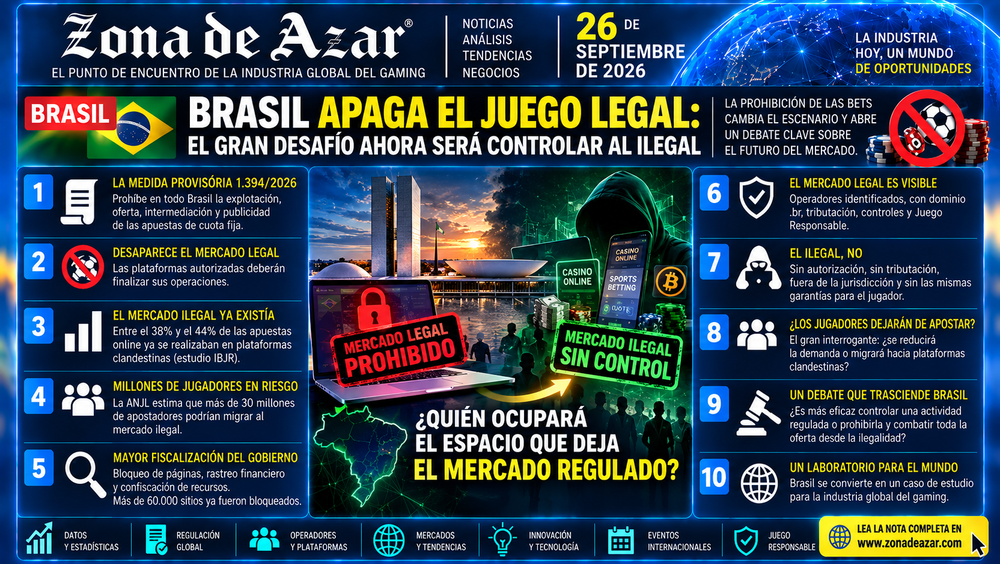
Brazil – 26 September 2026 – www.zonadeazar.com – The ban on fixed-odds betting introduced by the Government of Luiz Inácio Lula da Silva completely changes Brazil’s betting landscape: the authorised market that the State could identify, supervise and regulate disappears, while the challenge of combating clandestine platforms remains. The major question now begins: what will happen to players who want to continue betting, and where will that demand go?
PROVISIONAL MEASURE No. 1,394, OF 25 SEPTEMBER 2026
Brazil has taken a radical turn in its betting policy.
Provisional Measure No. 1,394/2026, published on 25 September, prohibits the operation, offering, intermediation and advertising of fixed-odds betting, including sports betting and online gaming.
The Government justifies the decision on grounds of public interest and the economic and social effects associated with betting. At the same time, it has announced that it will strengthen its fight against illegal operators.
But the decision opens another debate which, for Zona de Azar®, deserves particular attention.
The illegal market was already operating in Brazil
Brazil is not beginning its battle against clandestine betting now.
Before the ban, the illegal market already represented a considerable share of betting activity.
A study by LCA Consultores and Instituto Locomotiva, commissioned by the Instituto Brasileiro de Jogo Responsável (IBJR), estimated that during the first half of 2026, between 38% and 44% of online betting took place on clandestine platforms. The estimate comes from industry research and should be interpreted as such.
The Government itself had also been taking action against this supply.
On 24 September, the Ministry of Justice reported the removal of 1,367 Facebook and Instagram pages and profiles used to promote irregular platforms.
The Ministry of Finance also states that more than 60,000 betting-related websites have been blocked since 2024.
There is therefore one fundamental fact:
the clandestine market was not created by the ban. It already existed and represented one of the main challenges facing the regulated model.
The legal market is visible. The illegal market is not.
This is perhaps the most delicate point in the new scenario.
An authorised operator has a name, an identifiable domain, accountable individuals, traceable operations and obligations towards the State.
It must comply with technical and financial requirements, pay taxes, implement Responsible Gambling controls, establish anti-money laundering mechanisms, comply with advertising rules and submit to supervision by the Brazilian authorities.
A clandestine operator operates in a very different environment.
It does not apply for Brazilian authorisation. It does not pay an authorisation fee to operate legally. It does not voluntarily submit to SPA supervision and may attempt to offer its services from outside Brazil.
Until now, two markets coexisted.
One legal, visible and subject to supervision.
Another illegal, which the State attempted to identify, block and pursue.
The ban eliminates the first.
The second will have to be fought.
Brazil switches off the shop window it could control
This is where one of the most important paradoxes of the new policy emerges.
The debate does not need to be reduced to being either for or against betting.
From a regulatory perspective, there is a fundamental difference between an activity conducted by identifiable companies subject to State rules and the same activity conducted by clandestine operators.
Until now, Brazilian consumers had at least one objective reference point: .bet.br domains identified authorised operators within the federally regulated system.
With the disappearance of those platforms, that dividing line changes completely.
If some players decide to continue betting, the Government will have to prevent that demand from being captured by clandestine platforms.
And that could become the real challenge of the ban.
Will players stop betting?
That is the question no law can answer on its own.
The Associação Nacional de Jogos e Loterias (ANJL) argues that the ban could push more than 30 million bettors towards the illegal market. This is a projection from an industry association, not a proven outcome of the measure.
The Government takes a different position.
Its strategy is to accompany the ban with greater enforcement, website blocking, the tracking of financial transactions and the seizure of funds linked to clandestine operators.
The Provisional Measure itself creates an Interinstitutional Committee for the Supervision of the Illegal Operation and Advertising of Fixed-Odds Betting, showing that the Executive recognises that combating illegal supply will be a central part of this new phase.
We therefore have two scenarios that will have to be assessed against actual data over the coming months.
If the ban substantially reduces demand and the authorities succeed in preventing access to clandestine platforms, the Government will have moved towards its stated objective.
If players continue betting and a significant proportion migrate to illegal operators, Brazil will face a very different consequence: the activity will continue, but outside the system that was able to supervise it.
Who will protect the player?
This question is even more important than the economic debate.
Within the regulated market, the State could impose conditions.
It could require Responsible Gambling mechanisms, bettor identification, financial controls, anti-money laundering measures, complaints procedures and safeguards for players’ funds.
When dealing with a clandestine platform based outside Brazil, the authorities’ ability to intervene may be considerably more limited.
For this reason, the issue is no longer solely how much tax revenue Brazil may lose or how much companies that invested in the market may lose.
Other questions must also be asked:
Where will Brazilians who decide to continue betting place their bets?
Who will be behind those platforms?
Where will that money circulate?
What controls will exist?
And who will a Brazilian player be able to turn to when they have a problem with a clandestine operator?
There is no need to attribute intentions
The Lula Government says it intends to reduce the harm associated with betting and combat the illegal market. Its public actions include measures specifically aimed at blocking and supervising irregular platforms.
For that reason, there is no basis in the available information to claim that Lula is connected with, associated with or deliberately favouring the illegal sector.
Nor is such an accusation necessary to raise a much more important issue.
What will need to be assessed are the results of the policy that has been adopted.
And the question can be put directly:
Is it more effective to control a legal, visible and supervised activity, or to prohibit it and fight the entire supply from within the illegal market?
Brazil has now chosen the second path.
The answer will come from the facts.
A huge laboratory for the global industry
What happens in Brazil will be watched far beyond its borders.
Brazil built a regulated market, granted authorisations, established controls and, for almost two years, developed a structure designed to separate legal supply from clandestine operations.
Now it is changing direction.
From this point onwards, one of the most important indicators will no longer be the betting volume of the regulated market.
It will be another:
How many Brazilians will actually stop betting, and how many will continue doing so on illegal platforms?
If demand persists, the debate will take on an even greater dimension.
Because the issue will no longer simply be that Brazil has eliminated authorised betting operators.
The issue will be determining whether, by switching off the market it could see and control, Brazil ultimately created more room for the very market it wanted to combat.
That cannot yet be stated as a fact.
But from today, it is one of the fundamental questions Brazil will have to answer.
Zona de Azar® will closely follow developments in the market, official blocking figures, player behaviour and any eventual growth or reduction in clandestine betting activity.
Because banning betting can be done through legislation. Controlling what happens afterwards will be the real challenge.
Zona de Azar® – The meeting point of the global gaming industry.
Héctor Fontanella


