US Tribal Gaming Revenue Reached Record US$46.2 Billion
United States.– 28 July 2026 – www.zonadeazar.com The National Indian Gaming Commission reported that United States tribal gaming generated a record US$46.2 billion in gross gaming revenue during fiscal year 2025. The result represented year-on-year growth of 5.3% and reinforced the industry’s economic importance to tribal communities.
Overview
The United States tribal gaming market achieved its highest total on record during fiscal year 2025, generating US$46.2 billion in gross gaming revenue.
The figure represented an increase of US$2.3 billion from the US$43.9 billion reported in fiscal year 2024. In percentage terms, the sector delivered year-on-year growth of 5.3%.
The National Indian Gaming Commission compiled the total using independently audited financial statements submitted by 545 gaming establishments.
These operations were owned or operated by 246 tribal governments across 29 states. Seven of the NIGC’s eight regulatory regions reported higher revenue than in the previous fiscal year.
The result established a new record for the industry and confirmed the continued expansion of tribal gaming within the framework created by the Indian Gaming Regulatory Act.
The Method Used to Calculate Revenue
The NIGC defined gross gaming revenue as the total amount wagered by customers minus winnings returned to players.
The Commission collected the information annually to examine industry trends and guide its regulatory and supervisory policies.
Under United States legislation, each tribe was required to submit financial statements covering all financial activity from its Class II and Class III gaming operations on Indian lands.
The statements had to be filed within 120 days following the conclusion of each operation’s fiscal year. As gaming establishments could use different financial year-end dates, the NIGC received audited statements at various points throughout the calendar year.
Once all documentation was received, the Commission reviewed, analysed and consolidated the information to determine the annual result. Consequently, the fiscal year 2025 report could include revenue earned up to 16 months before its publication.
This process provided a comprehensive industry total while recognising the operational and accounting differences across hundreds of tribal gaming establishments.
Growth Across Seven of Eight Regions
Regional data showed widespread expansion, although the scale of growth varied considerably across individual markets.
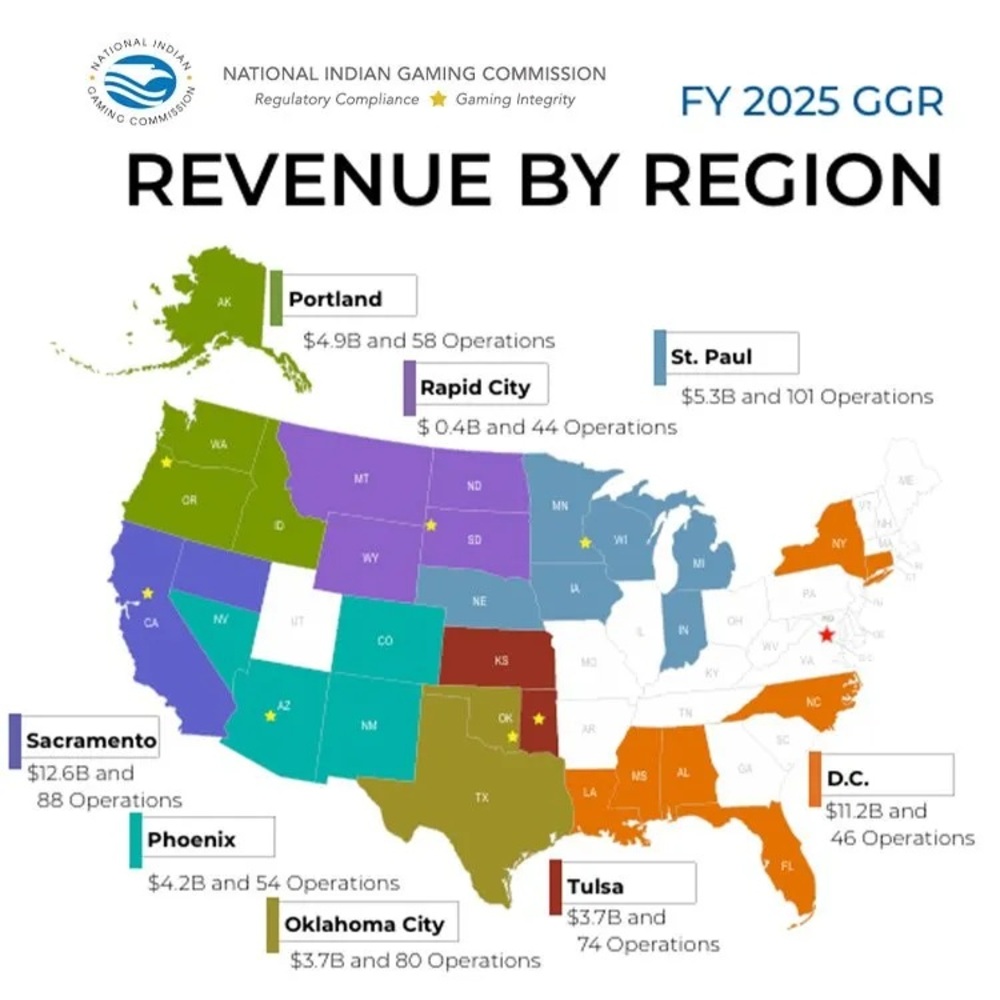
Sacramento remained the largest NIGC region by revenue, generating approximately US$12.6 billion, an increase of 4.1% from the previous year.
The Washington D.C. region reached about US$11.2 billion and recorded the highest percentage growth, advancing by 9.8%. Portland produced approximately US$4.9 billion and increased by 5.3%, while Phoenix reached US$4.2 billion, also achieving growth of 5.3%.
St. Paul recorded around US$5.3 billion, an increase of 2.9%. Tulsa reached almost US$3.7 billion, rising by 2.5%, while Oklahoma City generated approximately US$3.7 billion, up 3.3% from the previous fiscal year.
Rapid City was the only region to report a decline. Its revenue stood at approximately US$439.8 million, representing a reduction of 0.9%.
The Commission explained that year-on-year regional movements should not automatically be treated as direct measures of local economic performance. Results could be affected by openings, expansions, renovations, temporary or permanent closures, regulatory changes and differences in fiscal year timing.
Revenue Remained Concentrated Among Larger Operations
The report also demonstrated an uneven distribution of revenue between the industry’s largest and smallest establishments.
Approximately 9% of tribal gaming operations reported gross gaming revenue exceeding US$250 million during fiscal year 2025. Together, these businesses generated around 56% of the industry’s total GGR.
At the opposite end of the market, slightly more than 54% of establishments reported revenue below US$25 million. Although they represented more than half of the facilities included in the study, this group accounted for approximately 5% of total revenue.
The figures illustrated the coexistence of large destination casinos capable of attracting customers from several regions and smaller establishments primarily serving local communities and nearby markets.
Both groups formed part of a diverse ecosystem with significant variations in size, geography, commercial model and market reach, while remaining subject to the NIGC’s regulatory framework.
Statements From NIGC Officials
NIGC Vice Chair William “Billy” Kirkland emphasised the role of tribal gaming as a contributor to tribal economies and as a mechanism enabling sovereign governments to invest in their communities and provide essential public services.
NIGC Associate Commissioner Sharon Avery recognised the work of the Indian gaming community. She associated the strong results with the continued commitment of tribal regulators and operators to responsible growth and community benefit.
The officials indicated that industry development should be assessed not only through its revenue, but also through its contribution to economic autonomy, community investment and stronger tribal governments.
Their statements reinforced the connection between commercial performance and the wider social and institutional purpose assigned to tribal gaming under federal law.
Industry Context
The National Indian Gaming Commission was created in 1988 through the passage of the Indian Gaming Regulatory Act.
Its mission is to support tribal self-sufficiency and protect the integrity of Indian gaming through effective regulation. Its responsibilities include coordination with tribal, state and federal authorities, technical assistance, the review of ordinances and management contracts and regulatory oversight.
Revenue generated through tribal gaming helps fund public services, infrastructure, employment, education, healthcare and community development projects.
The industry also represents an economic expression of tribal sovereignty by providing revenue that reduces dependency and strengthens the institutional capacity of tribal governments.
The scale of the 2025 result demonstrated how gaming remained one of the most important economic tools available to many tribal nations across the United States.
Next Steps and Industry Impact
The 2025 record established a new benchmark for measuring the growth of the United States tribal gaming industry and confirmed the sector’s continued ability to expand.
At the same time, the concentration of more than half of total revenue among a relatively small group of large operations highlighted the considerable economic diversity that existed between regions and communities.
For regulators, the challenge will be to maintain consistent standards of oversight across more than 500 establishments with significantly different characteristics.
The results reinforced the importance of protecting market integrity, promoting responsible growth and ensuring that gaming’s economic benefits continue to support tribal self-sufficiency, public services and long-term community development. NIGC
🔗 Editó: @_fonta www.zonadeazar.com


