“Game Changers” Interview: Maria Bashkevich, Head of Marketing at Uplatform
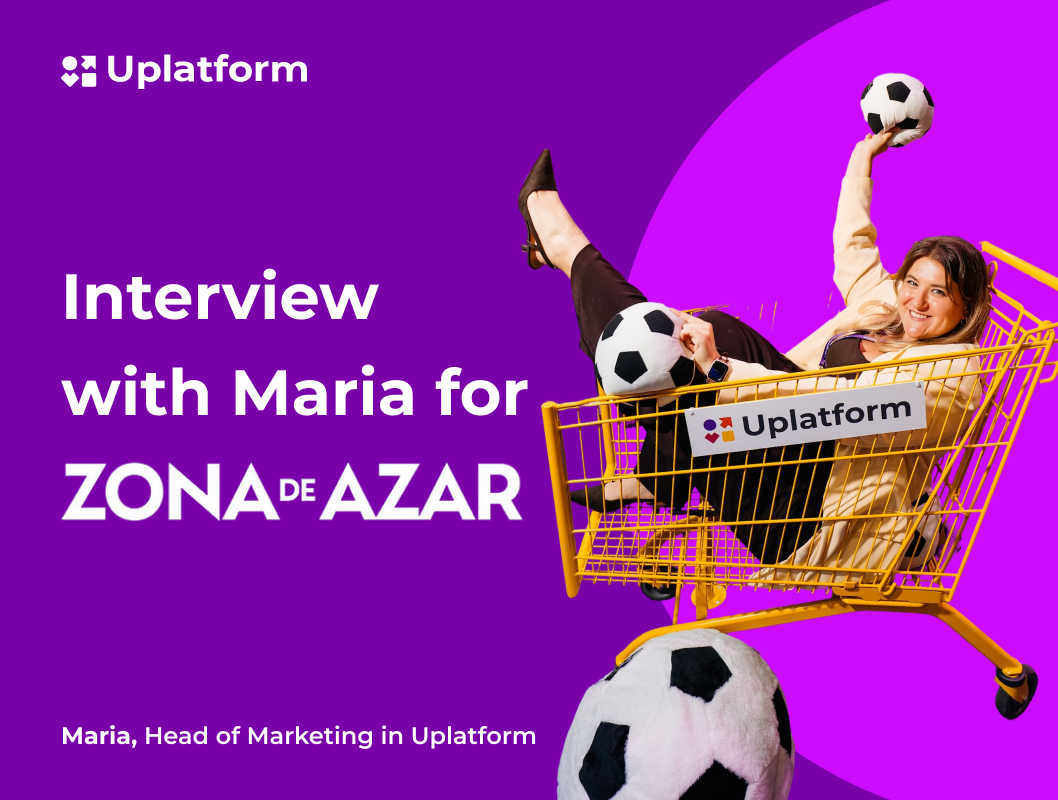
Cyprus.- September 23 2026 www.zonadeazar.com In an iGaming industry where everyone wants to stand out, being different is no longer enough. Behind every memorable brand, bold campaign or packed exhibition booth, there must be something deeper: strategy, data, market understanding and, ultimately, business results. Few people embody that intersection between creativity and performance as clearly as Maria Bashkevich, Head of Marketing at Uplatform.
In this exclusive interview with Zona de Azar, she goes beyond the surface of B2B marketing to discuss what it really takes to build a distinctive brand, why localization can make or break expansion in Latin America, how AI and data are reshaping market intelligence, and what leadership looks like when creativity and accountability have to coexist. And with SBC Summit Lisbon just around the corner, Maria also gives us a glimpse into how Uplatform plans to turn its “brand of your dreams” concept into an experience the industry will remember.
We hope you enjoy it as much as we enjoyed making it.
- María, you’ve described your journey at Uplatform as building the brand, the marketing strategy, and the team almost from scratch. Looking at where Uplatform stands today, what are you most proud of having built, and what do you think truly sets the brand apart in such a competitive B2B iGaming market?
First of all, I’m sorry – I clearly can’t do short interviews with short replies (smiles).
On a serious note, what I’m most proud of is probably the transformation itself – seeing what Uplatform has become as a brand and knowing how much work, change and evolution has happened behind the scenes to get us here.
On a personal level, I’m also proud of my own journey with the company. I had the opportunity to build a lot from the ground up – the brand direction, the marketing strategy, the team, the processes – and then continuously rethink and evolve all of it as both the company and I grew. Right now, for example, we’re going through another very transformational stage within the department.
From a marketing perspective, I think one thing that sets Uplatform apart is our willingness to be more creative and sometimes a little riskier in how we communicate. B2B iGaming, especially in the platform-provider vertical, can still be quite conservative. There are strong examples of bold marketing among game providers and affiliate businesses, but fewer platform brands are really experimenting with storytelling, language and visual identity.
We try not to present ourselves as just another technology provider listing features. We want to tell a story, build an idea around the brand, and create campaigns that people can actually feel and remember.
And for me, a campaign should really be a campaign – not just one creative reused in a few ads. We try to build one concept and carry it consistently across everything: exhibition booth, media banners, advertising, editorials, social media, merchandise and other touchpoints. When all of those elements work together and tell the same story, the brand becomes much stronger than the sum of individual marketing activities.
- You’ve always advocated for bold marketing and moving away from traditional gaming industry clichés. But as iGaming becomes increasingly competitive, simply being “different” is no longer enough. What must a brand actually do today to be memorable and, more importantly, to turn that visibility into real business opportunities?
Small disclaimer before I start: I definitely don’t consider myself a TEDx speaker or a LinkedIn Marketing Influencer, so I’m not going to pretend there’s one universal truth here. But I’m happy to share how I see it from my own experience.
I think the first mistake is trying to be different for the sake of being different.
Before thinking about bold visuals or a provocative tone of voice, a brand needs to answer some much more fundamental questions: Who are we? What do we actually stand for? What are our strongest USPs? Who is our ideal customer? What do we want people to feel when they interact with us? And, of course, what are we trying to achieve as a business?
Only after answering those can you start building the story and choosing the tools to tell it. Okay, not really – honestly, there are a whole lot more questions. And, of course, A LOT of research and analytics behind them.
But that part sounds boring, and I assume you want the fun stuff (She gives a playful, mischievous smile).
But the funny thing is, though, that this IS marketing. The boring tables, surveys, tests, data, research and endless analysis are what eventually allow you to create something bold that actually makes sense.
There is no single golden formula here. Every product is different, and every audience is different, so I believe every marketing mix should be different, too. If your strongest advantage is technology and innovation, for example, creating a medieval-themed campaign simply because nobody else is doing it would probably be weird as hell. Memorable, maybe. Relevant? Not necessarily.
For me, the key is finding something that feels distinctive but is still completely authentic to the product, the brand and the audience. For one company, that might come through content; for another, through events, product storytelling, community, visual identity, or something entirely different. You also need to be consistent—don’t change direction on a whim.
As for turning visibility into actual business opportunities… well, I’m not giving away all my secrets for free (laughs).
Jokes aside, this is probably one of the most interesting parts of marketing for me. From the outside, some of our campaigns or exhibition booths might simply look fun, but behind that fun there is a lot of planning: lead-generation mechanics, customer journeys, data, calculations, and very deliberate decisions about how we move people from attention to conversation.
And it’s never really “finished.” It’s a constant learning curve of testing, measuring what worked, understanding what didn’t, and incorporating those lessons into the next campaign implementing those lessons into the next campaign.
- You’ve spoken extensively about localization and the mistake of treating entire regions with a one-size-fits-all approach. Latin America is perhaps one of the clearest examples of this. Based on what Uplatform is observing today, what are international operators still misunderstanding about Latin America?
I think the biggest misunderstanding is still treating Latin America as one market.
It sounds obvious, but in practice we still see operators approaching the region with a very simplified playbook: regulation, translation, a few local payment methods… and assuming the job is done.
But localization goes much deeper than that.
Countries across Latin America can differ significantly in payment behavior, preferences, expectations, triggers, trust factors, seasonality and even in how people react to communication and promotions.
Even within the same language, the way you communicate matters. Tone, terminology, cultural references and expectations around customer experience can all vary. That requires research, local expertise, testing and, sometimes, accepting that a strategy that worked perfectly in one country simply won’t translate to another one.
That thinking is actually one of the reasons we recently launched a new project, Zoom In: The Profits Are in the Details. It’s a series of ebooks where we focus on individual markets and their specific characteristics, combining insights from our player research and surveys with broader data analysis and our own market expertise.
At the moment, we have three editions available – Argentina, Turkey and Malaysia – and the idea is to keep expanding the series with new countries and new insights over time.
- Brazil has transformed the debate surrounding regulated iGaming in Latin America, while other markets in the region are evolving at very different paces. From your perspective, where do you see the most interesting opportunities in Latin America for the coming years, and which markets deserve more attention than they currently receive?
Brazil, of course, is one of the most interesting markets right now and in many ways is setting the pace for the region. Beyond the size of the opportunity itself, I think the experience operators are gaining there will be extremely valuable in the future as regulation and the industry continue to develop across Latin America.
Of course, that doesn’t mean the Brazilian playbook can simply be copied into another country – quite the opposite, considering everything I said about localization earlier. But operators entering the region now are building knowledge, infrastructure and local expertise that can give them a strong foundation to scale as new opportunities emerge.
Peru, Chile and Argentina are obviously markets I would pay very close attention to, each for very different reasons and at very different stages of development.
And if we’re talking about markets that perhaps receive less attention, I think Ecuador is interesting to watch. I wouldn’t call it the next Brazil – and its regulatory and market development still needs to be followed carefully – but that’s exactly why markets like this are worth monitoring before they appear on everyone’s radar.
- Today, localization goes far beyond language: payments, regulation, sports preferences, technology, player behavior, and even cultural nuances can vary drastically from one market to another. How does Uplatform use technology, data, and artificial intelligence to make localization increasingly precise without losing the human understanding of each market?
I think the important thing is not to treat technology or AI as a replacement for local expertise. They help us move faster, process more information and make better-informed decisions – but you still need people to understand the context behind the data.
And speed is becoming increasingly important. Markets and player behavior change quickly, so it’s no longer enough to understand a market once – you need to continuously see what is changing and be able to adapt the product accordingly.
That’s where technology and data really help us. We’ve been developing internal tools that allow us to implement and scale local solutions much faster – from payments and providers to adapting product and content for specific audiences. More and more of what previously required manual analysis and configuration is now automated and driven by actual data.
We’re also developing our CRM and analytics capabilities, including AI and predictive analytics, to go beyond looking at what has already happened and start identifying patterns and potential scenarios across different player segments.
And then there’s the human layer, which for me remains critical. Data can tell you what is happening, AI can help you find patterns faster, but you still need expertise to understand why and what it means for you.
So for us, localization sits somewhere at the intersection of technology, data and human understanding – using the first two to scale without losing the depth and specificity of each market.
- Uplatform has made a name for itself by creating highly distinctive experiences at industry trade shows. With the SBC Summit Lisbon and other major events on the horizon, what can the industry expect from Uplatform? Could you give Zona de Azar a sneak peek at the events you’ll be attending and what you’re preparing for your partners and visitors?
For us, an exhibition booth should never be just a place with a logo, a bar and a few meeting tables. We always try to build a complete experience around a concept – something that reflects the brand, gives people a reason to stop, interact with us and, hopefully, remember us afterward.
At the same time, the “fun” part is only one layer. Events are also incredibly important for us commercially, so a lot of work goes into creating the right environment for conversations with existing partners, meeting new operators and making sure our team can actually use those few very intense days effectively.
For SBC Summit Lisbon, our concept is built around dreams – and around the idea that Uplatform is here to help operators build the brand and business of their dreams.
We’re taking that idea through the whole experience, so visitors can expect an interesting booth concept, cool merchandise, interactive elements and, of course, something delicious – kind of a Uplatform tradition by now.
And for operators, there will also be a special offer during the event, giving them the opportunity to start building the brand of their dreams and receive additional benefits. It’s definitely a good reason to come and talk to us.
After Lisbon, our next major stop will be ICE – and that will be something completely different. I can’t share much yet, but as always, people can expect a very visual and immersive experience.
We like every event to have its own story and mood, while still feeling unmistakably Uplatform.
- The industry invests enormous amounts of money in trade shows, sponsorships, and networking. As head of marketing, how do you measure whether an event like the SBC Summit Lisbon has been truly successful? Beyond contacts and meetings, what key performance indicators (KPIs) tell you that a trade show has genuinely strengthened Uplatform’s brand and market position?
You can’t imagine how much my event team hates me (She laughs playfully).
The short answer is: we don’t measure every event in exactly the same way.
Before each exhibition, we define what success should look like and assign different weights to different KPIs depending on the goals of that particular event. Commercial results are, of course, always extremely important, but some events may also have strong brand-awareness or even HR objectives.
On the commercial side, I’m trying to look beyond the number of contacts collected. Volume alone doesn’t tell you much – what matters is quality: how many contacts fit our ICP, convert into qualified opportunities, move through the funnel, and eventually contribute to pipeline and revenue. We also look at the efficiency behind those results – how much we invested in the event and, accordingly, the cost per qualified lead or SQL.
Then there is the brand layer: branded search, direct traffic, website and social engagement, media visibility, mentions, and the overall increase in attention around Uplatform. We also pay attention to qualitative signals – whether people recognize the brand, reference previous campaigns, actively look for us at the venue, or bring others to meet us. Those things are harder to fit neatly into one dashboard, but over time they tell you a lot about whether the brand is actually becoming more established in the market.
Depending on the event, we may also add HR, business development or partnership KPIs.
The important thing for me is not to fall into the trap of judging an event by how busy the booth looked or how many badges were scanned. A crowded booth can be great for photos and still deliver very little business value.
A successful trade show is one where the result matches the objective we set before we arrived – and where we can clearly understand what worked, what didn’t, and what we should change for the next one.
- You’ve developed a leadership style based on creative freedom, trust, and allowing people to contribute unconventional ideas. As Uplatform grows internationally, how do you preserve that creative culture without letting creativity stray from business objectives? Where do you strike the balance between giving the team freedom and demanding measurable results?
It’s a tough one—I’m still learning how to balance it, to be honest, and sometimes it’s really difficult.
I strongly believe in giving people creative freedom. I want my team to challenge ideas, bring something unexpected, disagree with me and experiment. Some of our strongest concepts came from giving people enough space to think beyond the obvious solution.
But freedom doesn’t mean a lack of structure, and creativity still needs a purpose. At the end of the day, marketing still has a business objective, and every idea needs to answer a fairly simple question: what are we trying to achieve with this?
That’s where the balance becomes difficult. Sometimes leadership means killing a beautiful idea that everyone loves because the simpler one will work better. That part is painful, especially for me, because I genuinely enjoy the creative side.
And measurable results are still non-negotiable. I don’t expect every experiment to succeed – otherwise it wouldn’t really be an experiment – but I do expect us to understand why we’re doing it, what we want to learn, and what the result tells us.
I definitely don’t think I’ve found the perfect formula yet. As the team and the company grow, my own leadership style keeps changing too. Sometimes I give too much freedom; sometimes I probably exercise too much control, and finding that middle ground is still very much a work in progress.
- In previous interviews, you’ve spoken very openly about the challenges you faced as a young woman entering leadership and about the importance of creating environments where people feel secure enough to express themselves and take risks. Today, with considerably more experience under your belt, has your definition of leadership changed? And what kind of leader do you still want to become?
It has definitely changed – and I hope it will keep changing.
When I first moved into leadership, I think a lot of my focus was on proving that I deserved to be there. I was young, I was managing people who sometimes had significantly more experience than I did, and I felt that being a good leader meant having the answers, making the right decisions, and somehow always knowing what to do.
With experience, I’ve become much more comfortable saying, “I don’t know,” asking my team for their opinion, or admitting that someone understands a particular subject much better than I do. I don’t think leadership is about being the smartest person in the room. My job is to build a team where I don’t need to be.
At the same time, my understanding of creating a safe environment has evolved too. I still strongly believe that people should feel comfortable speaking up, disagreeing with me, making mistakes and bringing ideas that might sound completely crazy at first. But psychological safety doesn’t mean the absence of accountability.
Sometimes leadership means having uncomfortable conversations, giving direct feedback, setting higher expectations or saying no. I’m still learning how to do that while preserving the trust and openness I value so much.
Another part of leadership for me is building the right environment for people to actually perform at their best. It’s not enough to hire talented people and give them freedom – you need the right structure around them. That means clear ownership, processes and responsibilities, but also understanding people’s individual strengths and, where possible, shaping roles around where they can create the most value.
And that structure isn’t static. As people grow, the team grows, and business priorities change, you sometimes need to move responsibilities around, rethink roles, or rebuild parts of the department entirely. There’s a lot of juggling involved in finding the combination where individual strengths and business needs create the biggest impact.
As for the leader I want to become, I want to be someone who creates strong, independent people rather than people who depend on me. I want my team to have ownership, confidence and enough space to become better at what they do.
And I want to become better at knowing when my team needs my involvement and when the best thing I can do is simply get out of their way.
I’m definitely not there yet. But maybe that’s also part of my definition of leadership now: you never really finish learning how to do it.
- Let’s look to the future. If we meet again in a year, what would you like to be able to tell Zona de Azar about Uplatform? What markets, innovations, achievements, or transformations would make you say, “This was a pivotal year for us”?
That’s a dangerous question because now you can come back in a year and check whether I actually delivered 😀
For me, there are two layers to that answer – business and personal.
Business-wise, I’d obviously love to be talking about significant growth in our client base, expansion into the right markets, and successful launches of the features and products we currently have on our roadmap. I won’t spoil those yet – you might want to follow Uplatform on LinkedIn to see the updates.
More broadly, I’d like to be able to say that Uplatform didn’t simply become bigger, but stronger and more mature as a business and as a brand. From the marketing side, that means an even stronger connection between what we do and actual business results – better data, stronger funnels, smarter acquisition and closer collaboration between marketing, sales and product.
And then there is my personal layer. As I mentioned earlier, my team is going through quite a significant transformation right now. A year from now, I want to look back and see that the changes I’m planning today actually worked – that we became more effective without losing our creativity.
I also have two huge projects ahead of me – SBC Summit Lisbon and ICE – so I’d very much like to come back next year and say that we absolutely nailed both of them. And, of course, that we achieved the goals I’ve set for myself and for the team.
Creatively, I hope we’ll still be doing things that make people come up to me and say, “Guys, I don’t know how you’re doing it, but this is GOOD.”
So if we meet again in a year and I can tell you that Uplatform has grown, our new products are performing well, my team has successfully gone through this transformation, we’ve delivered two fantastic major events, and I’ve achieved everything I planned – all while maintaining a relatively normal level of sanity – I’ll happily call it a pivotal year 😀
Edited by: @MaiaDigital www.zonadeazar.com


