“Game Changers” Interview: Wojtek Sznapka, CEO of Gamblitude
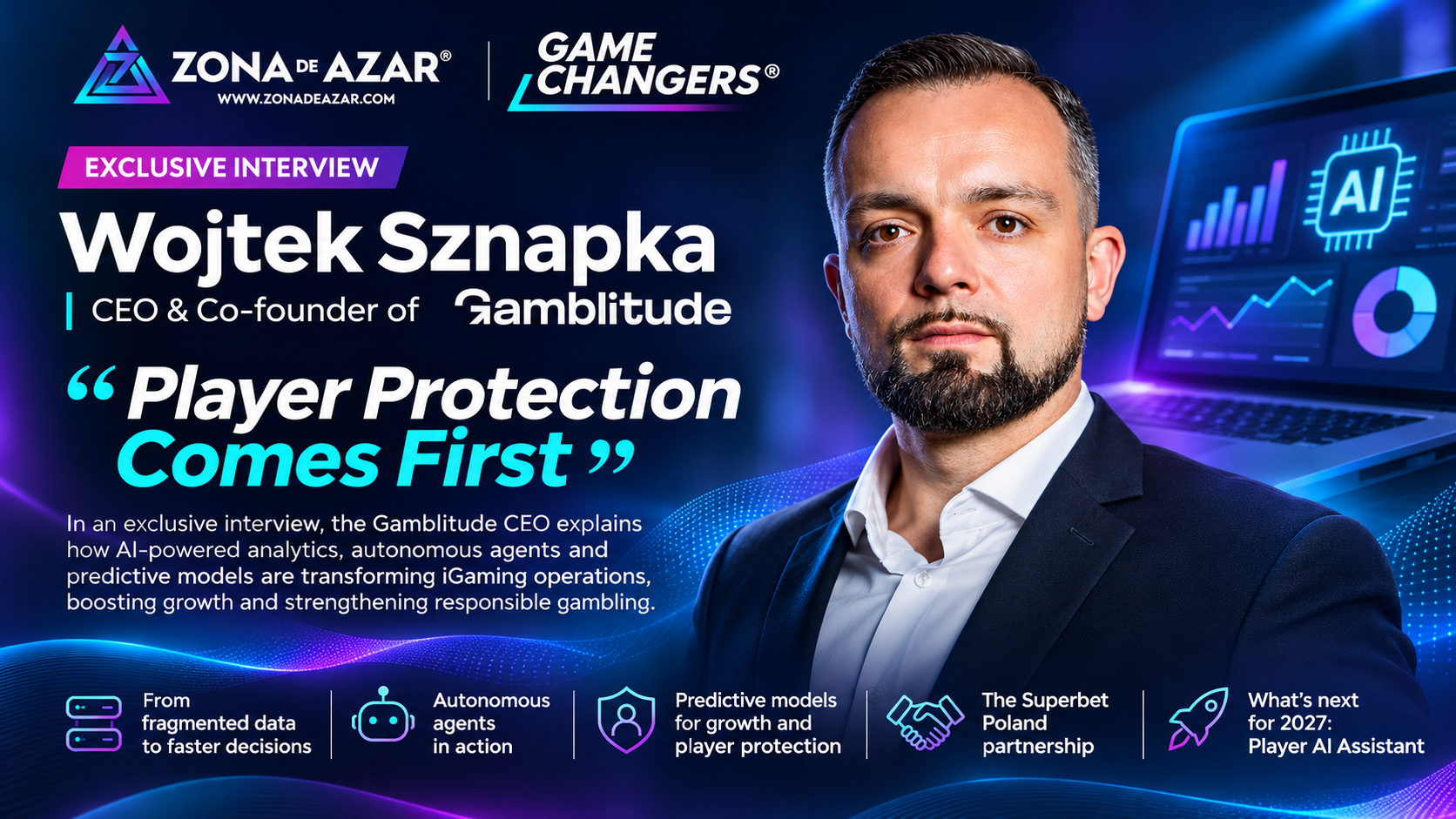
Poland.—November 12, 2026 www.zonadeazar.com In an exclusive interview with Zona de Azar’s Game Changers®, Wojtek Sznapka, CEO and co-founder of Gamblitude and former CTO of STS, shares his vision for the future of artificial intelligence in the iGaming sector and explains how AI-driven analytics, autonomous agents, and predictive models are transforming the way operators make decisions, drive growth, and protect players.
Drawing on his seven years of experience as CTO of Poland’s leading sports betting operator, Sznapka discusses Gamblitude’s collaboration with Superbet Poland—a SixValues case study in which the active adoption of data tools rose from approximately 20% to over 70%—and the challenges of turning fragmented data into reliable and actionable insights.
He also addresses a fundamental industry dilemma: the balance between commercial opportunities and responsible gaming, emphasizing that player protection must always take priority over commercial value.
Looking ahead to 2027, Sznapka reveals plans to expand Gamblitude’s AI capabilities and introduce a new “AI Player Assistant,” which will bring conversational AI directly to users of sportsbooks and casinos.
1. What led you to found Gamblitude?
I spent seven years as CTO at STS (Poland’s largest sports betting operator), leading the engineering and data teams. One experience that left a lasting impression on me was launching a brand in new markets. We had assumed that the central business intelligence (BI) team would handle reporting. Then, acquisition costs began to fluctuate, and we needed answers quickly. Our queries ended up in the same queue as requests from a much larger, more established company. I understood why the main market was prioritized, but it was frustrating when you were the one trying to execute the launch.
Both Piotr Cerlak and I had faced variations of that problem. We were already discussing it before we left STS. We founded Gamblitude because we wanted the people running the business to be able to answer more questions like that on their own.
2. What does a “decision layer” mean in practice?
Imagine you’ve just launched a campaign. On the first day, you want to know at what point users drop off—between registration and their first deposit. A month later, you want to know if the campaign has paid for itself once you factor in the bonuses and what you spent to acquire those players. One answer could change what you’re going to tweak this afternoon. The other could change where next month’s budget is allocated. Both teams should be able to analyze the same group of players and see how the numbers were calculated. That’s what I mean by a “decision layer.”
3. How do you move from fragmented data to answers that people can actually use?
We connect data from operations, payments, bonuses, and player acquisition, and then agree with the operator on what the key metrics mean. Once that’s done, a team can start with a dashboard and ask the agent a follow-up question using the same definitions. They can do this as long as the question remains relevant.
At SixValues, about one in five employees actively used data tools before the change. After standardizing their KPIs and enabling self-service access, that figure rose to over 70%. More people could access the information on their own, and analysts had more time for tasks that required their expertise.
4. How will autonomous agents change an operator’s day-to-day work?
I was surprised by how much our clients used the analytics that were generated without anyone having requested them. Imagine opening your dashboard in the morning and seeing that deposit approvals have dropped. An agent may have already investigated this and discovered that most of the drop is due to a single payment provider. That gives the payments team a starting point.
In the coming years, I believe agents will increasingly take on that initial review. I’d evaluate them based on how often they find something the team is glad to know. If every little fluctuation becomes an alert, people will stop paying attention very quickly.
5. How do predictive models help with growth and player protection?
A forecast of a player’s future value can help you compare acquisition channels while you still have time to make adjustments to the budget. A churn score gives you a reason to examine the case more closely. An early VIP score can help the team identify potential high-value players and offer them a more personalized service, in accordance with the operator’s VIP eligibility and player protection policies.
When it comes to responsible gaming, the question is whether a change in behavior warrants a more detailed analysis by the player protection team. I would check two things over time: Did the model detect the cases the team needed to examine? And was the follow-up actually helpful? These are two distinct aspects that need to be measured.
6. What happens when the same behavior points to both a potential VIP and a gambling risk?
Player protection comes first. If someone suddenly starts making deposits more frequently and playing for longer periods, a business model might interpret this as an indication of future value. The player protection team must analyze what has changed and whether the person needs help.
I would agree with the rule that this should be done before any of the scores reach the CRM. If there is any cause for concern that requires review, promotional contact should be suspended and the case referred to the player protection team. The decision rests with them, regardless of the player’s commercial value. Furthermore, the policy must be implemented in the campaign system so that an offer scheduled yesterday can be paused today.
7. What does the partnership with Superbet Poland mean for Gamblitude?
Piotr and I have been working in the Polish operator sector for years, competing against Superbet, so this partnership means a lot to us. We bring our expertise in AI and predictive modeling to Superbet’s Polish business. They develop much of their own technology, and I know from having been on the other side of the table just how carefully they choose what to incorporate into that system.
8. How do you build trust in AI-based analytics?
We created Gamblitude so that the AI answers questions using only metrics and definitions that have already been verified. Take a question like “What was yesterday’s sportsbook margin?” The agent uses the same definition as the operator’s reports, down to specifying which bets count and when the reference day ends. The result goes through several layers of validation before the agent displays it to you.
And if you’re going to make a decision based on that figure, you should be able to see how it was calculated and verify it yourself. That’s especially important when the decision affects a player.
9. What are your priorities for 2027?
We’ll continue to improve the Gamblitude platform, especially in terms of what our AI agent can do for operators. It’s already capable of analyzing what’s happening in the business. I want it to be more useful in the next phase—such as getting results to the right person and helping them follow up.
We’re also going to launch a new line of products for players, starting with the AI Assistant for Players. Most of what we’ve developed so far has been aimed at people working at operator companies. I’d like that same technology to make things easier for players as well. They should be able to ask what bets are available for a game, how a game works, or what the rules of a promotion are. The assistant can also help with account-related questions, follow up on a support request, or send a reminder that the player has requested.
People are already getting used to asking AI assistants for help with everyday tasks. I think it’s about time they could do the same with their sportsbook or casino.
10. What advice would you give to executives who want to make a difference with AI?
I was skeptical when the current wave of AI began. What changed my mind was using it for tasks I understood well enough to verify.
The most important part of any AI implementation is getting the data in order. Compare the figures with the source and make sure the agent knows what those figures mean. If the finance and marketing departments calculate revenue differently, even the best model needs to know which definition applies. Otherwise, it can give you a very convincing answer based on an incorrect figure.
Next, choose a decision your team makes every week and sit down with the people who make it. Find out what takes them the most time. Test the AI on some cases they’ve already handled and see where it goes wrong.
Then, test it in the actual workflow with the same people. A month later, ask them how much time they’ve saved and what they still have to double-check. That conversation will tell you a lot about where to invest next.
Edited by: @MaiaDigital www.zonadeazar.com


