Brazil Bans Betting: What Happens Now to Investors’ Legal Certainty?
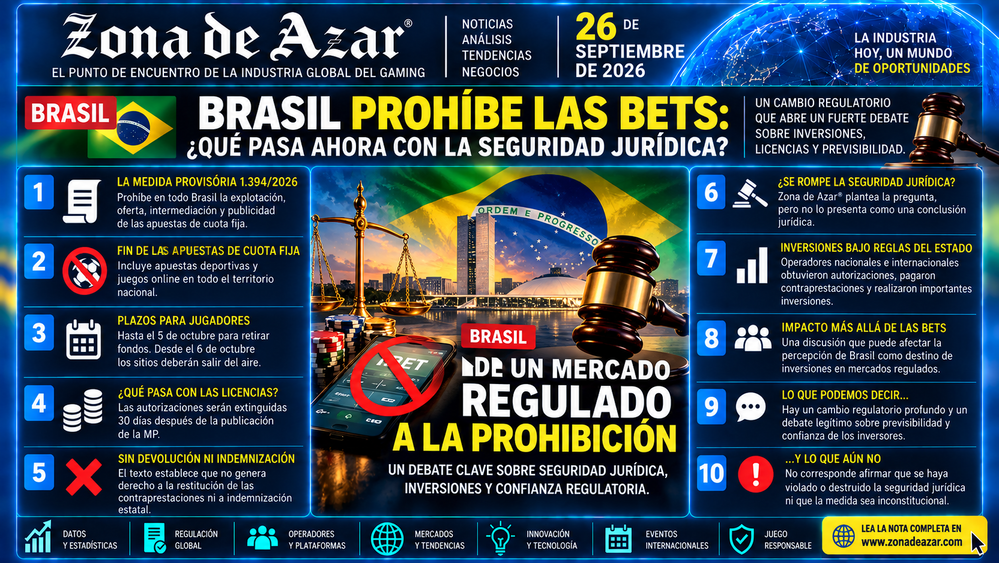
Brazil – 26 September 2026 – www.zonadeazar.com – The Brazilian Government’s decision to ban fixed-odds betting represents a radical change for a market that had been regulated by the State itself. National and international operators obtained authorisations, paid the required fees and made investments to comply with regulatory requirements. The new situation raises an unavoidable question: what happens to regulatory predictability and legal certainty for those who invested relying on those rules?
On 25 September, the Brazilian Government published Provisional Measure No. 1,394/2026, prohibiting the operation, offering, intermediation and advertising of fixed-odds betting throughout the country, including sports betting and online gaming.
The decision represents a profound change for an industry that had moved towards a fully regulated model.
Brazil had established specific requirements covering authorisations, supervision, consumer protection, advertising, Responsible Gaming, anti-money laundering and sports integrity.
From a regulated market to prohibition
The issue is not simply whether a State can change its policy towards betting.
States can, of course, change their laws and regulatory policies within their constitutional framework.
The central question is what happens when such a change affects companies that legally entered a market created and regulated by that same State, obtained authorisations, paid the required fees and made significant investments to comply with those requirements.
The Provisional Measure provides for existing authorisations to be terminated 30 days after its publication and states that this termination, justified by the Executive on public-interest grounds, does not, according to the text of the measure, create a right to full or partial reimbursement of the amounts paid for those authorisations or to State compensation.
This could become one of the central points of legal debate.
Has Brazil broken legal certainty?
Zona de Azar® believes that the question should be raised, but should not yet be presented as a definitive legal conclusion.
It would not be accurate to state as a fact that “Brazil has broken legal certainty.”
It is appropriate, however, to recognise that a regulatory change of this magnitude opens an important debate about regulatory predictability, legitimate expectations and investments made under a framework previously established by the State itself.
Operators entering the regulated market had to adapt their platforms, introduce controls, meet technical and financial requirements, implement Responsible Gaming and anti-money laundering policies, and obtain the corresponding authorisations.
That environment has now changed radically.
An issue that goes beyond betting
The debate could extend well beyond the betting industry.
For international companies considering entry into a regulated market, the stability and predictability of the rules are relevant factors when making long-term investment decisions.
Brazil has moved from legalising, regulating, authorising and supervising fixed-odds betting to establishing its prohibition through a Provisional Measure.
This does not automatically mean that Brazil no longer provides legal certainty.
It does, however, raise a question that is likely to remain with the market in the coming weeks:
How predictable is an investment made under a regulated framework when the rules underpinning that investment can subsequently change so profoundly?
What we can say — and what we cannot say yet
What can be stated today is that Brazil has introduced an extraordinarily significant regulatory change, leaving authorised companies facing a completely different environment from the one in place when they decided to enter the market.
It is also reasonable to say that the decision opens a legitimate debate about legal certainty, regulatory predictability and investor confidence.
What cannot yet be presented as established fact is that Brazil has “violated”, “destroyed” or definitively “broken” legal certainty, or that the measure is unconstitutional.
Those questions will have to be examined through the political, legislative and potentially judicial processes that now follow.
The question itself is powerful enough:
What certainty does a company have when making long-term investments in a regulated market if the rules that made that investment possible can subsequently change radically?
Brazil has just opened that debate.
Zona de Azar®


