Brazil’s New Chamber Divided Over Gambling With 277 Untested MPs
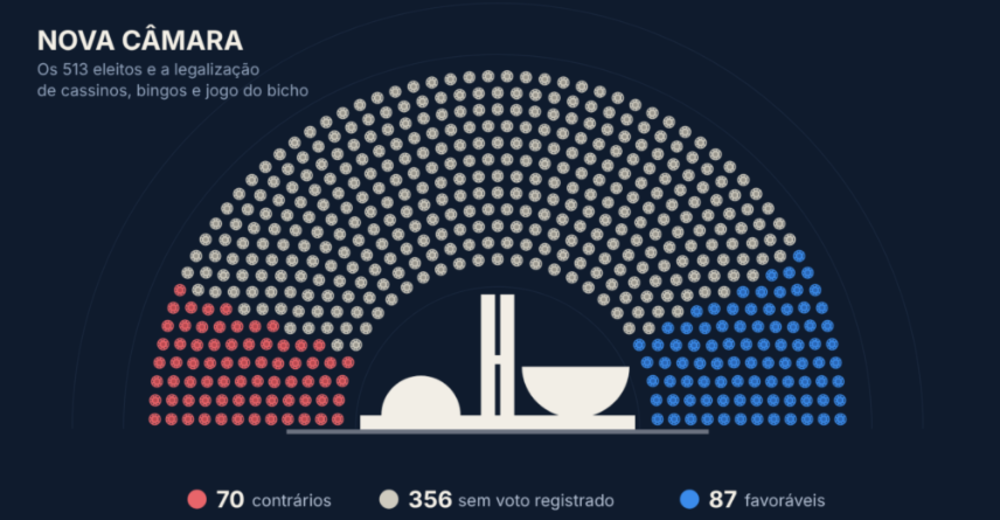
Brazil.- 7 October 2026 | www.zonadeazar.com Brazil’s Chamber of Deputies elected on 4 October will take office in February 2027 without a clear majority on the legalisation of casinos, bingo and jogo do bicho.
An analysis of all 513 elected deputies also shows that 277 lawmakers, representing 54% of the Chamber, have no voting history on either of Brazil’s two main recent gambling and betting debates.
87 in Favour and 70 Against
Of the 513 deputies elected, only 157 participated in the February 2022 vote on Bill 442/91, Brazil’s broader gambling regulatory framework.
Among them:
- 87 voted in favour.
- 70 voted against.
The remaining 356 either did not hold a seat at the time or were absent from the vote.
Casinos, Bingo and Jogo do Bicho
Bill 442/91 was approved by the Chamber in 2022 by 246 votes to 202.
The proposal provides for the legalisation and regulation of activities including casinos, bingo and jogo do bicho.
It is currently before the Senate as Bill 2,234/22.
Should senators amend the text, it would return to the Chamber and be considered by the new composition elected in 2026.
Gambling and Betting Are Separate Debates
The analysis distinguishes between two legislative issues.
The first is the broader gambling framework established through Bill 442/91.
The second concerns fixed-odds betting and online gaming, debated under Bill 3,626/23 and subsequently enacted as Law 14,790/2023.
Voting records show that support for one framework does not necessarily translate into support for the other.
Deputies Who Changed Position
Among the 67 elected deputies who participated in both votes, 16 took different positions across the two pieces of legislation.
Eleven supported broader gambling legalisation in 2022 but opposed the fixed-odds betting framework in 2023.
Five followed the opposite path.
The divergence illustrates that casinos, bingo and jogo do bicho do not necessarily generate the same political positions as sports betting and online gaming.
Betting Regulation Vote
In December 2023, Brazil’s fixed-odds betting legislation passed by 292 votes to 114.
The analysis has so far identified the vote of 146 deputies elected in 2026:
- 87 voted in favour.
- 59 voted against.
The reconstruction of this vote remains incomplete for several party groups.
Differences Among Major Parties
The two largest parliamentary groups show differing voting histories on broader gambling legalisation.
Among elected PT deputies who participated in the 2022 vote, 18 out of 19 opposed the proposal.
Within PL, 19 voted against and 16 in favour.
By contrast, PP members with a recorded vote backed the proposal by 13 to two, while MDB deputies split nine to three in favour.
277 Deputies Without a Voting Record
The biggest area of uncertainty is the 277 deputies who did not participate in either of the two votes analysed.
Among the largest groups:
- PL: 60 of 123 deputies have no recorded vote.
- PT: 47 of 69.
- União Brasil: 31 of 46.
Their positions could become especially important if the broader gambling framework returns from the Senate or if the new Chamber is required to consider further changes to online betting policy.
Both Rapporteurs Remain
The rapporteurs of both major gambling-related bills remain in the Chamber.
Felipe Carreras of PSB-Pernambuco served as rapporteur for Bill 442/91.
Adolfo Viana of PSDB-Bahia handled the fixed-odds betting legislation.
Their continued presence leaves the new legislature with two lawmakers who have direct experience of the regulatory debates.
Legislative Context
The incoming Chamber will take office amid an unusually active period for Brazilian gambling policy.
Congress is still dealing with Provisional Measure 1,394/2026, while the Senate has yet to complete consideration of the broader framework covering casinos, bingo and jogo do bicho.
The new Chamber could therefore play a role in both processes.
Next Steps or Impact
Existing voting records do not point to a clear majority in the incoming Chamber.
More than half of elected deputies have no recorded vote on either of the two main recent gambling proposals.
The future of the broader regulatory framework may therefore depend heavily on the positions adopted by these lawmakers once the relevant proposals return to the Chamber floor.
Editó: @fonta


