Brazil: Court Provisionally Reinstates a Betting Licence
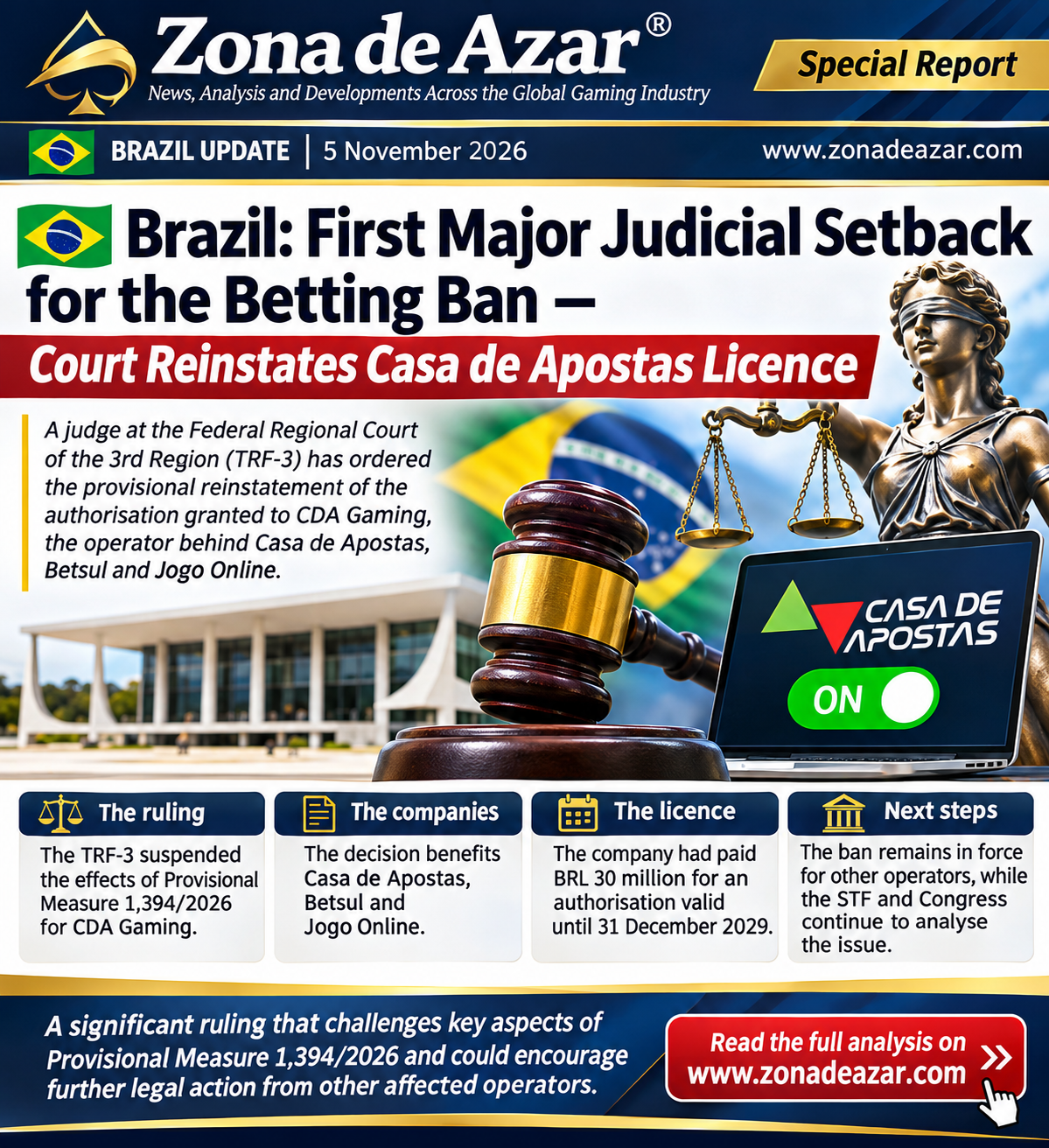
🇧🇷 Brazil: First Major Judicial Setback for the Betting Ban — Court Reinstates Casa de Apostas Licence
Brazil – 5 November 2026 – www.zonadeazar.com Brazil’s Federal Judiciary has opened a new chapter in the controversy surrounding the ban on sports betting and online gaming. A judge at the Federal Regional Court of the 3rd Region (TRF-3) has ordered the provisional reinstatement of the authorisation granted to CDA Gaming, the operator behind Casa de Apostas, Betsul and Jogo Online. The ruling challenges fundamental aspects of Provisional Measure 1,394/2026 and could encourage further legal action by other affected operators.
A Ruling That Shakes the Brazilian Market
On 3 November 2026, while Brazil’s Supreme Federal Court (STF) was holding a public hearing on the constitutionality of the betting ban, Federal Appellate Judge Adriana Pileggi de Soveral issued a ruling of considerable significance for the Brazilian gaming industry.
The judge, a member of the Federal Regional Court of the 3rd Region, granted interim relief to CDA Gaming Ltda., suspending the effects of Provisional Measure 1,394/2026 insofar as they had resulted in the premature termination of the company’s operating authorisation.
The decision allows the reinstatement of the online domains and the operational, financial and payment services required to conduct the authorised activities.
The brands benefiting from the ruling are Casa de Apostas, Betsul and Jogo Online.
However, the ruling is provisional, and its effects are limited exclusively to CDA Gaming.
The Government Had Granted a Licence Valid Until 2029
One of the central elements of the dispute is that CDA Gaming had obtained its authorisation under SPA/MF Ordinance No. 255/2025, issued by the Secretariat of Prizes and Betting within Brazil’s Ministry of Finance.
To enter the regulated market, the company paid BRL 30 million, securing an authorisation valid until 31 December 2029.
However, on 25 September 2026, the Brazilian Government introduced Provisional Measure 1,394/2026, banning fixed-odds betting and online gaming and providing for the early termination of existing authorisations.
The legislation made no provision for the proportional reimbursement of licence fees or compensation for affected companies.
This became one of the central arguments underpinning the judicial ruling.
Legal Certainty: The Decisive Argument
The judge considered that the premature cancellation of operating authorisations could breach fundamental constitutional principles, particularly legal certainty, reasonableness and proportionality.
The court’s reasoning raises a question of enormous importance for any regulated industry:
Can a government charge a licence fee for a specified period, require companies to invest in regulatory compliance, and subsequently revoke that authorisation without providing any form of compensation?
The ruling challenges the notion that public interest considerations can be used to abruptly disregard legal arrangements previously established by the authorities themselves.
It also questions the use of a provisional measure to implement the ban, raising concerns about whether the constitutional requirements of relevance and urgency had been satisfied.
The court did not deliver a definitive ruling on the constitutionality of the legislation. Nevertheless, its reasoning represents a significant challenge to the manner in which the Government implemented the prohibition.
The Stake Precedent Calls for Caution
The favourable ruling for CDA Gaming is not the first attempt by a betting operator to secure judicial protection against the ban.
In October, Stake also obtained a favourable interim ruling, which was subsequently suspended following an application by the Federal Government.
This precedent demonstrates how quickly provisional judicial decisions can be overturned or modified.
The distinction in CDA Gaming’s case is that the favourable decision was issued by an appellate judge at the TRF-3.
Nevertheless, this does not prevent the Brazilian authorities from pursuing further appeals.
It would therefore be premature to interpret the ruling as the beginning of a widespread reopening of the Brazilian betting market.
The Supreme Federal Court Continues to Examine the Ban
The TRF-3 ruling coincided with the public hearing held on 3 November at the Supreme Federal Court, convened as part of the constitutional challenges to Provisional Measure 1,394/2026.
During the hearing, industry representatives, sporting organisations and public authorities presented opposing positions.
The Ministry of Finance defended the prohibition, arguing that regulation had failed to adequately address the social and economic harm associated with betting.
Representatives of the regulated industry, meanwhile, questioned whether eliminating licensed operators could strengthen the illegal betting market.
Brazilian football also expressed concerns over the potential loss of sponsorship revenue.
According to estimates presented by the Brazilian Football Confederation, 27 of the 40 clubs competing in the country’s top two divisions had betting companies as their principal sponsors.
The combined value of these agreements was estimated at approximately BRL 1 billion.
The hearing concluded without a definitive ruling from the STF.
Could Other Companies Obtain Similar Rulings?
The CDA Gaming decision could provide legal arguments for other operators that paid licence fees, made substantial investments and subsequently lost their authorisations.
Among the issues likely to gain further prominence are:
- The protection of investments made under an officially established regulatory framework.
- The possibility of claiming compensation for the premature termination of operating authorisations.
- The proportionality of restrictions imposed by the Government.
- The use of provisional measures to fundamentally alter a regulated economic activity.
- The consequences of the prohibition for the illegal market, employment, tax revenues and sport.
Nevertheless, each company will need to assess its individual legal position and the prospects of obtaining judicial protection.
The ruling does not constitute a binding precedent that automatically reinstates the licences of other operators.
Congress Will Also Play a Decisive Role
While the judicial controversy continues, Provisional Measure 1,394/2026 remains subject to the legislative process.
The parliamentary timetable includes further important dates throughout November, against a backdrop of differing positions among the Government, betting operators, football clubs and judicial authorities.
The combination of interim judicial decisions, constitutional challenges and parliamentary debate has created considerable uncertainty over the future of the Brazilian market.
In this context, forthcoming decisions by the STF and the National Congress could prove decisive.
Zona de Azar® Editorial Conclusion
The favourable ruling for Casa de Apostas does not mean that Brazil has lifted its betting ban. It means something legally different, but potentially far-reaching: the courts have begun to establish limits on the consequences of a prohibition affecting authorisations previously granted by the State itself.
The issue is no longer confined to the social debate over whether betting should be permitted or prohibited.
It now also encompasses legal certainty, investor confidence, the State’s contractual obligations and the rights of companies that entered the market in full compliance with official regulatory requirements.
For an industry that has invested millions in licences, technology, regulatory compliance, employment and sports sponsorship, this debate extends far beyond the individual case of CDA Gaming.
Consumer protection and the prevention of gambling-related harm are legitimate public policy objectives. The controversy centres on whether those objectives justify the immediate cancellation of existing authorisations without transitional arrangements or compensation.
Brazil now faces a decisive question: how can society be protected without undermining the legal certainty of a market that the State itself chose to regulate?
The answer remains unresolved.
Zona de Azar® will continue to monitor developments at the Supreme Federal Court, the National Congress and Brazil’s federal courts, together with their implications for the gaming industry in Brazil and across Latin America.
Zona de Azar® — News, analysis and developments across the global gaming industry.


